
Last Updated on 26 April, 2026 by Yieldova
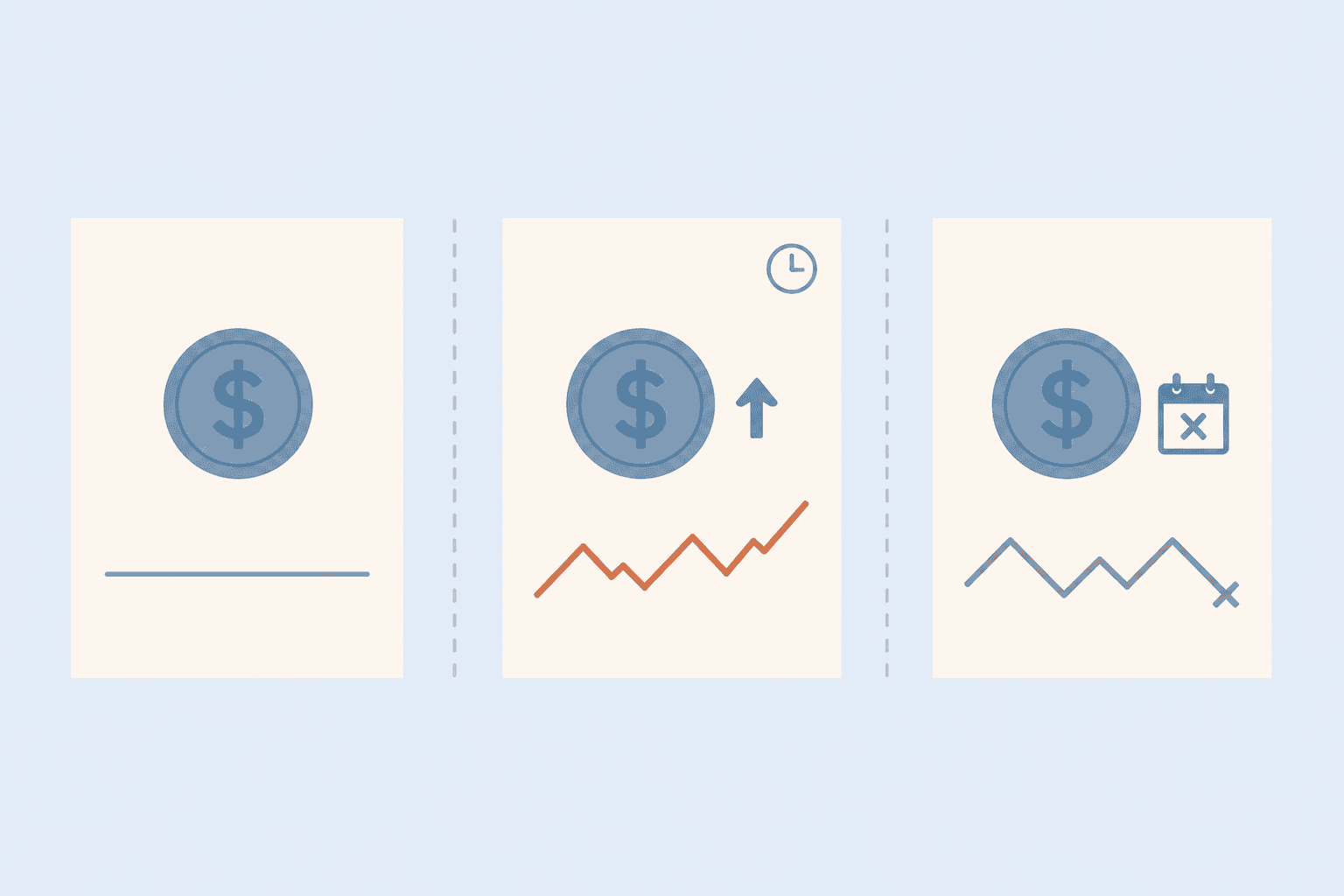
Spot vs perpetuals vs futures: three products, same underlying asset, three completely different ways to lose money.
ℹ Quick answer
Spot — you own the actual coin. Best for long-term holding and beginners.
Perpetuals — leveraged contracts with no expiration, settled via funding payments every 8 hours. Best for active trading.
Futures — leveraged contracts with a fixed expiration date. Best for hedging and basis trading.
Most retail traders open a crypto exchange, see “Spot,” “Futures,” and “Perpetuals” as tabs in the same interface, and assume they’re roughly the same thing with slightly different settings. They aren’t. They’re three structurally distinct instruments with different cash flows, different risk profiles, and different ways of going to zero.
This article walks through what each one actually is — mechanically, not marketing — and when each makes sense to use. By the end you’ll know why the same “long BTC” trade can be profitable in one product and ruinous in another.
Spot: The One That Actually Owns the Coin
Spot trading is the simplest of the three. You buy Bitcoin, you own Bitcoin. No expiration, no leverage by default, no funding payments. The exchange holds the coins on your behalf (or you withdraw them to your own wallet), and your P&L is just the difference between what you paid and what you sell for.
Mechanically:
Buy 1 BTC at $60,000  →  You own 1 BTC, value $60,000
Price moves to $66,000  →  You own 1 BTC, value $66,000
P&L = +$6,000 (+10%)

Price moves to $54,000  →  You own 1 BTC, value $54,000
P&L = -$6,000 (-10%)
That’s the whole instrument. Every other crypto product is a derivative of this — a contract that references the spot price without giving you the coin itself.
ℹ Key concept
Spot is the only product where you actually own the underlying. Everything else is a contract. That distinction sounds academic until your exchange goes down or restricts withdrawals — at which point owning the coin and owning a contract referencing the coin become very different things.
What spot is good for
- Long-term holding — no funding cost, no expiration, no liquidation
- Withdrawing to self-custody — only spot lets you take coins off the exchange
- Tax simplicity — in most jurisdictions, spot trades produce simpler tax events than derivatives
- Beginners — no leverage means no liquidation, which removes the fastest way to lose everything
What spot is bad for
Capital efficiency. To get $100,000 of BTC exposure on spot, you need $100,000. On a perpetual at 10x leverage, you need $10,000. That’s not automatically better — leverage cuts both ways — but for traders running multiple positions or hedging strategies, spot is capital-inefficient by design.
Futures: The One With an Expiration Date
A futures contract is an agreement to buy or sell an asset at a specific price on a specific future date. Crypto futures generally settle in cash (USDT or coin-margined) rather than physical delivery — you never actually receive the BTC, you just settle the difference between contract price and spot price at expiration.
The defining feature is the expiration date. Common crypto futures expire quarterly: March 28, June 27, September 26, December 26. Each contract is a separate instrument with its own price.
Today (price BTC = $60,000):
Buy 1 BTC June futures contract at $61,500

Why is the futures price higher than spot?
→ "Contango" — the market expects price to rise,
   or there's a cost-of-carry premium baked in.

At expiration (June 27):
Spot price = $65,000
Settlement = $65,000 - $61,500 = $3,500 profit per contract

If spot at expiration = $58,000:
Settlement = $58,000 - $61,500 = -$3,500 loss per contract
The price gap between futures and spot — the “basis” — is where the entire futures market lives. When futures trade above spot, the market is in contango. When futures trade below spot, it’s in backwardation. These conditions reflect what the market collectively expects, and they’re tradable on their own (basis trading is a real strategy, mostly run by funds with cheap capital).
↯ Practical implication
Crypto quarterly futures are mostly used by institutions for hedging and basis trades. Retail volume on dated futures is a fraction of what it is on perpetuals. Unless you have a specific reason to want a fixed expiration, this is probably not your product.
Perpetuals: Futures Without Expiration
Perpetual contracts (“perps”) are the dominant crypto derivative — by far. They behave like futures but never expire. You can hold a perp position indefinitely, as long as you maintain margin.
Which raises the obvious problem: if a contract never expires, what keeps its price tied to spot? A normal future converges to spot at expiration by mathematical necessity. A perpetual has no expiration, so it needs another mechanism. That mechanism is the funding rate.
How funding works
Every 8 hours (on most exchanges), longs and shorts exchange a payment based on whether the perp is trading above or below spot.
If perp price > spot price:
   → longs pay shorts (positive funding)
   → incentivizes shorting, discourages longing
   → pulls perp price down toward spot

If perp price < spot price:
   → shorts pay longs (negative funding)
   → incentivizes longing, discourages shorting
   → pulls perp price up toward spot
This is why a perpetual stays roughly tethered to spot price even though it can technically trade at any price. The economics force the alignment, not the contract structure.
Funding rates are typically small — 0.01% per 8 hours is normal — but they compound. At 0.01% per period, that’s 0.03% per day, roughly 11% annualized. In hot markets where everyone wants to be long, funding can spike to 0.1% or higher per period, which annualizes well above 100%.
Put differently: funding alone can erase your entire trading edge before direction has anything to say about it. A trader with a 15% annual edge on directional calls who pays 18% annualized in funding is, mechanically, a losing trader — regardless of how good the calls were.
⚠ Warning
Funding is invisible until it isn’t. Holding a long perp during a euphoric bull run can cost you 1–3% per month in funding alone, even if the price doesn’t move. Many retail traders blame their losses on bad timing when the actual culprit is months of funding payments compounding against them.
Why perpetuals dominate
For active traders, perpetuals solve every annoyance of dated futures: no rolling between contracts, no expiration date to track, no basis convergence to time, leverage on demand, and deep liquidity on the major venues. For retail, the appeal is simpler: high leverage with one tap.
Spot vs Perpetuals vs Futures: Direct Comparison
| Property | Spot | Futures | Perpetuals |
|---|---|---|---|
| Owns underlying | Yes | No | No |
| Expiration | Never | Fixed (quarterly) | Never |
| Leverage | Usually none | Up to 100x+ | Up to 100x+ |
| Funding payments | None | None (basis instead) | Every 8 hours |
| Liquidation risk | No | Yes | Yes |
| Withdraw to wallet | Yes | No | No |
| Best for | Holding, beginners | Hedging, basis trading | Active trading, leverage |
| Liquidity | High on majors | Moderate | Highest in crypto |
Leverage: The Real Source of Most Losses
The single most important difference between spot and derivatives is leverage. Spot trades at 1x by default. Perps and futures let you size up — 5x, 10x, 50x, sometimes 100x or more.
Leverage is often described as “amplifying returns.” That framing is misleading. What leverage actually amplifies is position size relative to your capital, which means it amplifies the percentage move that wipes you out.
Account: $1,000
BTC price: $60,000

Spot (1x):
   Buy 0.0166 BTC for $1,000.
   BTC needs to drop 100% to wipe you out.
   Realistically: never.

Perp at 10x:
   Open $10,000 position with $1,000 margin.
   BTC needs to drop ~10% to wipe you out.
   Frequency in crypto: monthly, sometimes weekly.

Perp at 50x:
   Open $50,000 position with $1,000 margin.
   BTC needs to drop ~2% to wipe you out.
   Frequency in crypto: daily.

Perp at 100x:
   Open $100,000 position with $1,000 margin.
   BTC needs to drop ~1% to wipe you out.
   Average wick on a 1-minute candle: enough.
The asymmetry is what destroys retail accounts. A 50x trade that wins 2% returns 100% on capital. A 50x trade that loses 2% returns -100% on capital. The math doesn’t care which one happens first, but the second one ends the trader’s account permanently.
⚠ Warning
Exchange data consistently shows that the majority of retail perpetual traders lose money over any meaningful timeframe. The leverage isn’t the only reason, but it’s the main one. The product is designed to be used carefully by people with risk frameworks, not aggressively by people guessing at direction.
Liquidation: How the Position Actually Dies
When you open a leveraged position, the exchange calculates a liquidation price — the price at which your margin is no longer sufficient to cover potential losses. If price reaches that level, the exchange forcibly closes your position to prevent your account from going negative.
Two things make liquidation worse than people expect:
1. The liquidation price isn’t the price of total loss — it’s the price of partial loss plus a liquidation fee. Most exchanges charge 0.5% to 1% on liquidated positions. So you don’t just lose your margin; you lose your margin minus fees that get paid to the insurance fund.
2. Liquidations cascade. When BTC drops 5% in a minute, it’s usually because thousands of liquidations are firing simultaneously, each one selling into a falling market, accelerating the drop, triggering more liquidations. The liquidation price calculated when markets were calm doesn’t account for the slippage during the cascade.
Real example structure (any liquidation cascade):

Step 1: Price drops 1% — small leveraged longs liquidated
Step 2: Liquidation orders sell into thin book — price drops another 1.5%
Step 3: Mid-leverage longs hit their stop — more selling
Step 4: 5x and 10x positions start liquidating in cascade
Step 5: Total move 8–15% in minutes, recovers most of it within the hour

What retail experiences:
   "I had a stop at -5%. I got filled at -9%."
   The stop didn't fail. The order book did.
↯ Practical implication
If you’re using leverage, your position size should be calculated against worst-case slippage, not against the liquidation price the exchange shows you. The displayed liquidation price assumes orderly markets. Real liquidations rarely happen in orderly markets.
Margin: Cross vs Isolated
One last mechanical detail that catches people off guard. When you open a derivative position, you choose between isolated margin and cross margin.
Isolated margin — only the margin you assigned to that specific position is at risk. If the position liquidates, your other positions and your wallet balance are untouched. The trade-off is that you can’t add more margin automatically, so the position liquidates faster.
Cross margin — your entire account balance backs the position. The position can survive larger drawdowns because it draws on more capital, but if it does liquidate, it can take the rest of your account with it.
✓ Why this matters
Isolated margin is almost always the right default for retail. Cross margin is for traders running offsetting positions where one position’s gains naturally cushion another position’s losses — most retail isn’t doing that. They’re just one-way directional, and cross margin turns a single bad trade into an account wipeout.
Which Product for Which Use Case
The decision tree is simpler than the products make it look.
You want to hold long-term and possibly self-custody: spot. No exceptions. Derivatives are not for holding; they’re for taking positions.
You want to trade actively with leverage: perpetuals. The deep liquidity, no-expiration structure, and tight spreads on majors make this the standard tool.
You want to hedge a spot position or play basis spreads: dated futures. Quarterly contracts give you predictable expirations and clean basis to trade.
You want exposure but don’t want to deal with funding: dated futures, or just spot. Perps will bleed funding in any sustained directional market.
You’re new to crypto: spot only. Get comfortable with the asset class before adding leverage. The market will still be there in six months, and so will perpetuals — but only if your account survives the learning curve.
Where to Trade Each Product
The exchange you pick matters more than people think. Liquidity, fees, funding rate consistency, and platform reliability all affect actual execution costs in ways that compound across hundreds of trades.
The major venues for each product, with the trade-offs:
- Spot — every major exchange has decent spot liquidity on BTC and ETH. The differences appear on smaller coins, fee tiers for active traders, and withdrawal fees. Binance typically offers the deepest spot books and the lowest fees at scale.
- Perpetuals — Binance and OKX dominate by volume. Bybit is competitive on smaller pairs. dYdX and Hyperliquid are the major decentralized alternatives if self-custody during the trade matters to you.
- Quarterly futures — CME for institutional cash-settled futures, Binance and OKX for retail-accessible coin-margined and USDT-margined contracts.
If you’re comparing exchanges seriously, the framework matters more than the brand — proof of reserves, jurisdiction, fee structure, security history. We covered how to evaluate them properly in a separate guide.
↯ Practical implication
For perpetual trading, having accounts on at least two exchanges isn’t paranoia — it’s basic operational hygiene. Funding rate differences between venues create arbitrage opportunities, and platform outages during high-volatility moves are a real and recurring problem. One-exchange traders are more exposed than they realize.
The Bottom Line
The trader who loses money on perpetuals usually got the direction right at least half the time. What they got wrong was the instrument.
Spot, futures, and perpetuals share the same chart but produce completely different outcomes. Spot rewards patience and ownership. Futures reward expertise in basis and timing. Perpetuals reward execution discipline — and punish the lack of it faster than any other product in retail finance.
Most of the people who lose money in crypto don’t lose it on spot. They lose it on perpetuals, with leverage, while believing they’re trading the same thing they were holding three months ago. The chart looks the same. The instrument isn’t.
If you’re going to use derivatives, understand the mechanics first — funding, liquidation, margin mode, slippage during cascades. None of these are complicated individually. They become catastrophic when stacked together by a trader who learned the product by clicking buttons and hoping the arrow points up.
↯ Final reminder
The product isn’t the strategy. Spot is not “safe” and perpetuals are not “advanced” — they’re different tools. Pick the one that matches what you’re actually trying to do, and size the position so that being wrong is recoverable.

I’ve spent years trading crypto futures and building automated arbitrage systems across exchanges. I started Yieldova to share what, in my opinion, actually works in live markets. I’ve had losing streaks, blown strategies, and a few wins worth writing about. Everything here is based on real experience.