
Last Updated on 30 April, 2026 by Yieldova
Before you trade, you need to understand where you’re trading — and why it matters more than most people think.
What Is a Crypto Exchange?
A crypto exchange is a platform that connects buyers and sellers of digital assets. When you buy Bitcoin, you’re not buying it from the exchange itself — you’re buying it from another user who wants to sell. The exchange is the infrastructure that makes that transaction possible: it matches orders, holds funds, and settles trades.
This sounds simple, but the details matter enormously. The exchange you choose affects the prices you get, the fees you pay, the assets you can access, and — critically — the safety of your funds. Choosing the wrong exchange has cost traders everything.
CEX vs DEX: The Two Models
There are two fundamentally different types of crypto exchanges:
Centralized exchanges (CEX) — platforms like Binance, Bybit, and Coinbase that are run by a company. You create an account, deposit funds, and the exchange holds your assets on your behalf. The exchange matches your orders against other users. CEXs offer the best liquidity, the fastest execution, and the most trading pairs — but they require you to trust the platform with your funds.
Decentralized exchanges (DEX) — platforms like Uniswap or dYdX that run on smart contracts. You connect your own wallet, trades execute on-chain, and no company holds your funds. The tradeoff: lower liquidity, higher complexity, and slower execution.
This guide focuses on CEXs — which is where the overwhelming majority of trading volume happens and where most traders operate.
How a Centralized Exchange Works
When you place an order on a CEX, it goes into an order book — a real-time list of all pending buy and sell orders at different prices. The exchange’s matching engine pairs compatible orders: if you want to buy at $50,000 and someone else wants to sell at $50,000, the trade executes.
Two types of orders define how you interact with the order book:
Maker orders — orders that add liquidity to the book. If you place a limit order that doesn’t execute immediately, you’re a maker. Exchanges reward makers with lower fees because they improve market depth.
Taker orders — orders that remove liquidity by matching against existing orders. Market orders are always taker orders. Taker fees are higher because you’re consuming liquidity the exchange needs.
This maker/taker distinction is one of the most important fee concepts in trading — and one that most retail traders ignore.
The Metrics That Actually Matter
Fees — the most visible cost, but not always the biggest one. Maker/taker fees typically range from 0.01% to 0.10% per trade. At high frequency, these compound dramatically. A strategy with 10 trades per day at 0.04% taker pays over 140% of capital annually in fees alone.
Liquidity — how much volume trades on the platform daily. Higher liquidity means tighter spreads and less slippage. On illiquid exchanges, your market order moves the price against you before it fills.
Security — the exchange’s track record, insurance funds, and custody practices. Several major exchanges have been hacked or collapsed. This is not theoretical risk.
Jurisdiction and regulation — which countries the exchange serves, what KYC it requires, and how it’s regulated. This affects what products you can access and what legal recourse you have if something goes wrong.
API quality — for algorithmic traders, the reliability, latency, and rate limits of the exchange’s API matter as much as the fee structure. A great fee structure is worthless if the API drops connections during volatile markets.
⚠ Critical reminder
Not your keys, not your coins. Funds held on a centralized exchange are a liability on that exchange’s balance sheet, not your property in the traditional sense. FTX’s collapse in 2022 — which wiped out billions in user funds overnight — is the clearest possible demonstration of this risk. Only keep on exchanges what you need for active trading.
What the Exchanges Don’t Tell You
Spread on market orders — the difference between the best bid and best ask at the moment you execute. On illiquid pairs or during volatile periods, this spread can dwarf the stated taker fee.
Funding rates on perpetuals — if you hold leveraged futures positions, you pay or receive a funding rate every 8 hours. During extreme market conditions, annualized funding rates can exceed 100%. This cost is invisible in the fee schedule but very visible in your P&L.
Withdrawal fees — fixed fees per withdrawal that can be significant for smaller transfers. Always check the withdrawal fee for the specific network you’re using.
Regulatory risk — exchanges operating outside clear regulatory frameworks can be shut down or restricted with little notice. Binance’s 2023 settlement with the US Department of Justice and the ongoing regulatory pressure on offshore platforms is a real ongoing risk.
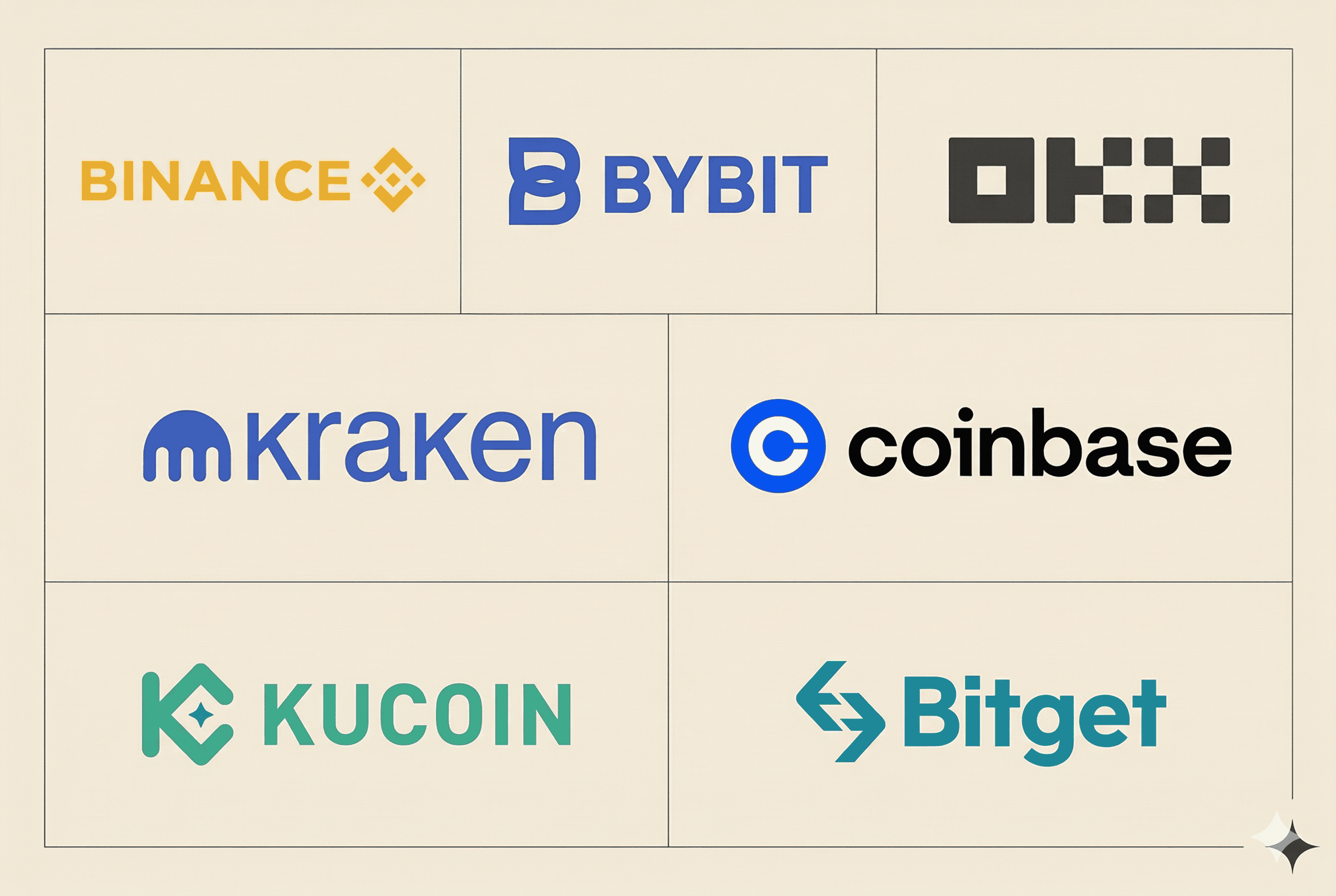
A Closer Look at Each Exchange
Binance
The largest crypto exchange in the world by trading volume, and the undisputed leader in futures and derivatives. Binance processes more volume in a single day than most exchanges handle in a week. That liquidity advantage is real — spreads on major pairs are consistently tighter than anywhere else, and slippage on large orders is minimal.
For active spot and futures traders, Binance offers the best combination of liquidity, fee structure, and available pairs. The futures platform — with maker fees as low as 0.02% — is the benchmark all other exchanges are measured against. For algorithmic traders, Binance’s API ecosystem is the most mature in the industry: extensive documentation, high rate limits, WebSocket support, and a large developer community. The main caveat is regulatory: Binance has faced significant legal pressure globally, including a 2023 settlement with the US Department of Justice, and is not available to US residents on its main platform.
→ Full Binance review: real fees, execution quality, API reliability, and regulatory risks — coming soon
Bybit
Bybit started as a pure derivatives exchange and built its reputation among futures traders who needed a fast, reliable alternative to Binance. It has since expanded into spot trading and a full product suite, but futures remain its core strength — and it’s where Bybit consistently delivers.
The interface is cleaner than Binance’s and many traders find it easier to navigate, particularly for managing leveraged positions. Bybit is a strong choice for futures traders who want deep liquidity, competitive fees, and a platform designed specifically around derivatives. The copy trading feature is one of the best-implemented in the industry. Not available to US residents.
→ Full Bybit review: futures performance, fees, liquidity, and platform stability under volatility — coming soon
OKX
OKX is the exchange most serious about bridging centralized and decentralized trading. Beyond a competitive futures and spot platform, it offers deep DeFi integration, an embedded Web3 wallet, and one of the cleanest APIs in the industry. For algorithmic traders who also want exposure to on-chain opportunities, OKX is the only CEX that genuinely serves both worlds well.
Fees are competitive, liquidity on major pairs is strong, and the platform has maintained a clean security record. The API is widely regarded as more consistent and better documented than Bybit’s, making it a strong second choice for algo traders after Binance. Not available to US residents.
→ Full OKX review: fees, API consistency, DeFi integration, and trading performance — coming soon
Kraken
Kraken is the exchange that has most consistently prioritized security and regulatory compliance — and it shows. It has never been hacked, a distinction very few major exchanges can claim, and has been proactive about working within regulatory frameworks in the US and Europe.
For beginners and traders who prioritize the safety of their funds above all else, Kraken is the most defensible choice. Kraken Pro offers a full trading interface with significantly lower fees than the standard platform and is what serious traders should use. The tradeoff compared to offshore alternatives is higher fees and a more limited derivatives offering. Available to US residents.
→ Full Kraken review: security track record, fees, regulation, and real trading experience — coming soon
Coinbase
The most regulated and most beginner-friendly exchange in the US market. Coinbase’s standard interface is designed for users buying their first Bitcoin — making it the right starting point for complete beginners who want the simplest, most regulated onramp into crypto. The focus on compliance, clear custody practices, and a publicly listed structure give it an institutional credibility that offshore exchanges can’t match.
For active trading, Coinbase Advanced (formerly Coinbase Pro) is the right product — it offers a proper trading interface and fees that are competitive within the US market, though still higher than offshore alternatives. Available to US residents.
→ Full Coinbase review: fees, ease of use, custody model, and Advanced trading features — coming soon
KuCoin
KuCoin’s main differentiator is breadth — it lists more altcoins than any other major exchange, making it the go-to platform for traders looking for exposure to smaller projects before they list on larger platforms. If you trade altcoins actively or want early access to new tokens, KuCoin is worth having as a secondary exchange.
Fees are competitive, the interface is functional, and liquidity on major pairs is solid. The regulatory situation is less clear than Kraken or Coinbase — KuCoin has faced legal issues in several jurisdictions. Best used as a secondary exchange for altcoin exposure, not as a primary platform. Not available to US residents.
→ Full KuCoin review: altcoin access, fees, liquidity, and regulatory risks — coming soon
Bitget
Bitget has grown rapidly on the back of two features: competitive futures trading and a well-executed copy trading product. Its copy trading platform is arguably the most developed in the industry, with detailed statistics on signal providers, transparent performance histories, and fine-grained controls for followers.
For traders interested in systematic copy trading — either as a follower or as a signal provider building a track record — Bitget deserves serious consideration. Futures fees and liquidity are competitive with Bybit. Not available to US residents.
→ Full Bitget review: copy trading performance, futures fees, and platform reliability — coming soon
ℹ Final note
Most serious traders end up using two exchanges: one primary platform for their main trading activity, and one secondary for access to specific assets or as a backup. Don’t consolidate everything on one exchange — the counterparty risk isn’t worth it.
References
- U.S. Securities and Exchange Commission. (2022). SEC Charges Samuel Bankman-Fried with Defrauding Investors in Crypto Asset Trading Platform FTX. Available at: https://www.sec.gov/newsroom/press-releases/2022-219
- U.S. Department of Justice. (2023). Binance and CEO Plead Guilty to Federal Charges in $4B Resolution. Available at: https://www.justice.gov/archives/opa/pr/binance-and-ceo-plead-guilty-federal-charges-4b-resolution
- Glosten, L. R., & Milgrom, P. R. (1985). “Bid, Ask and Transaction Prices in a Specialist Market with Heterogeneously Informed Traders.” Journal of Financial Economics, 14(1), 71–100.

Articles published under the Yieldova byline combine market data, primary sources, and hands-on trading experience. Every piece goes through the same standard: if we wouldn’t stake money on it, we don’t publish it.