
Last Updated on 23 April, 2026 by Yieldova
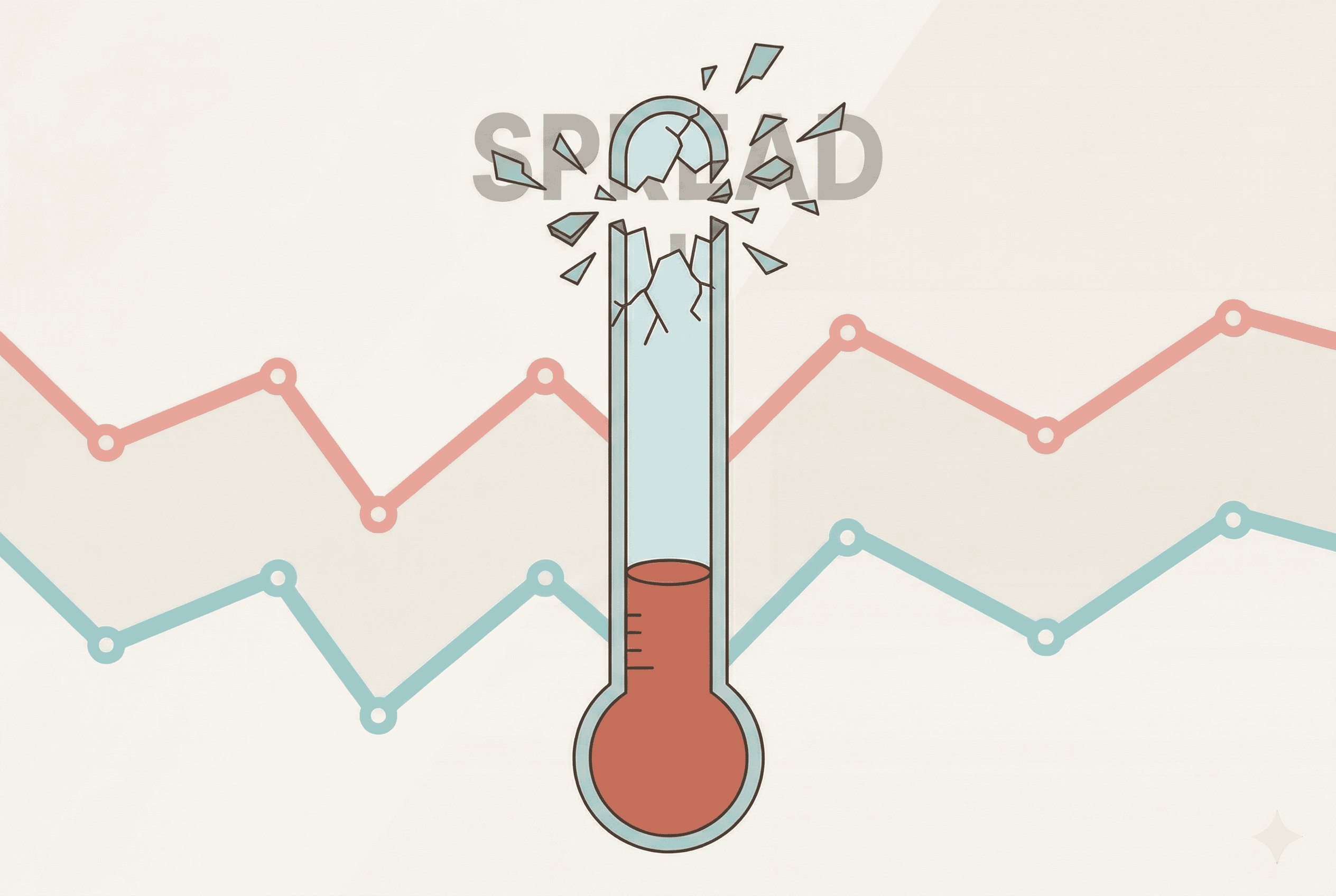
The spread looks like a small, stable cost. It is neither small nor stable when it matters most.
The Cost You Think You Know
Every trader knows about the bid-ask spread. It’s the first thing you learn about market microstructure — the difference between what a buyer pays and what a seller receives, pocketed by the market maker in between. A few cents on a stock. A few pips in forex. A fraction of a percent in crypto. Small enough to feel negligible on any individual trade.
The problem is that most traders think of the spread as a fixed, predictable cost — like a toll booth that charges the same amount every time you pass through. Backtest it as a constant. Budget for it as a constant. Evaluate strategy performance assuming it stays constant.
It doesn’t. The spread is a dynamic variable that responds to market conditions in real time. In the moments when you most want to trade — around news events, at market opens, during liquidity events — it can expand by a factor of 5, 10, or more. A strategy backtested with a fixed spread assumption is operating on a fiction. The real cost of spread is the average across all conditions, weighted by when your strategy actually trades — and that number is almost always worse than the fixed figure used in testing.
What the Bid-Ask Spread Actually Is
At any moment in a liquid market, there are two prices for any asset:
- The bid — the highest price a buyer is currently willing to pay
- The ask — the lowest price a seller is currently willing to accept
The spread is the difference between the two:
Spread = Ask price − Bid price
Spread % = (Ask − Bid) / Mid price × 100
When you buy at market, you pay the ask. When you sell at market, you receive the bid. The round-trip cost of entering and exiting a position — assuming nothing else changes — is one full spread. If the spread is 0.10%, a complete round trip costs you 0.10% of the position size before anything else.
The spread exists because market makers — the entities that provide continuous buy and sell quotes — bear inventory risk. When a market maker sells you an asset, they’re now short that asset and need to manage that exposure. The spread is their compensation for providing liquidity and taking on that risk. When conditions make the risk higher — more volatility, more uncertainty, thinner liquidity — market makers widen the spread to protect themselves. That cost gets passed directly to you.
ℹ Spread vs commission
Spread and commission are both transaction costs but operate differently. Commission is explicit — a fixed fee charged per trade regardless of conditions. Spread is implicit — embedded in the price you receive and invisible on most broker interfaces. Both reduce your net edge; spread is harder to track precisely because it varies with market conditions and isn’t itemized on your trade confirmation.
Why Spreads Are Dynamic, Not Fixed
The spread at any moment reflects the market maker’s real-time assessment of two things: how much inventory risk they’re taking on, and how much competition they face from other market makers.
When markets are calm and liquid — mid-session on a major asset, no pending news, normal volume — market makers are comfortable quoting tight spreads. Their inventory risk is manageable, they can hedge easily, and competition from other market makers keeps spreads narrow. This is the environment that most backtests implicitly assume all the time.
When conditions change, the calculus shifts. Higher volatility means the price can move significantly before a market maker can hedge their position — so they widen the spread to cover that risk. Lower liquidity means fewer counterparties and less ability to offload inventory — so they widen further. Uncertainty around an imminent news event means any position they take could immediately move against them — so they widen dramatically or pull their quotes entirely.
The result is a spread that can be 0.02% in normal conditions and 0.20% or higher in stressed conditions on the same asset. That 10x variation is not unusual during major events — it’s the norm.
↯ The invisible cost problem
Unlike commissions, spread expansion is invisible on most broker interfaces. Your trade confirmation shows the fill price, not the spread at the moment of execution. The only way to know what spread you paid is to compare your fill price to the mid-price at the exact moment of your order. Most traders never do this — which means they’re systematically underestimating their real execution costs.
When Spreads Expand: The Four Moments That Matter
Market opens — the first minutes after a market opens are the single worst time for spreads on most assets. Overnight, market makers have accumulated uncertainty about fair value — news has broken, futures have moved, pre-market activity has repriced things. When the regular session opens, they widen spreads aggressively until the order flow gives them enough information to establish a tighter range. On liquid US equities, spreads at the open can be 3-5x the mid-session level. On crypto, where there is no defined open but liquidity follows patterns, the equivalent moments are around major timezone transitions.
News and macro events — Federal Reserve decisions, CPI releases, NFP data, earnings reports, and geopolitical events cause immediate and dramatic spread expansion. In the seconds before and after a major announcement, market makers either widen spreads to extreme levels or withdraw their quotes entirely — leaving only stale limit orders in the book that execute at prices disconnected from fair value. Any market order sent during these windows will fill at a significantly worse price than the screen showed when you clicked. This is not slippage in the traditional sense — it’s spread expansion, and it’s predictable and avoidable.
Off-hours and low-liquidity periods — forex and crypto trade continuously, but liquidity follows the sun. EUR/USD has tight spreads during the London-New York overlap and much wider spreads during the Asian session when European and American market makers are absent. Crypto spread patterns follow similar logic — liquidity is thinnest during late US hours and early Asian hours. Strategies that trade around the clock will experience dramatically different spread costs depending on when their signals fire.
Low-volume assets — the structural spread on a thinly traded asset is wider to begin with, and it expands more aggressively during stress because there are fewer market makers competing to provide liquidity. A small-cap stock, a minor forex pair, or an altcoin with thin volume can see spreads that are 5-10x those of major liquid assets in normal conditions — and multiples of that during events.
The Math: What a Variable Spread Actually Costs
The danger of variable spreads is not the average — it’s the concentration. Spread expansion tends to happen precisely when your strategy generates signals, because news and volatility create the price movements that trigger entries. A strategy that trades around events is systematically entering and exiting at the worst possible spread conditions.
Consider a strategy that generates 400 trades per year, with the following spread distribution:
Normal conditions (80% of trades):   spread = 0.04%
Elevated conditions (15% of trades): spread = 0.15%
Event conditions (5% of trades):     spread = 0.40%

Weighted average spread:
(0.80 × 0.04) + (0.15 × 0.15) + (0.05 × 0.40)
= 0.032 + 0.0225 + 0.020
= 0.0745%
A backtest using a fixed 0.04% spread assumption — the normal-conditions figure — underestimates the true average spread cost by nearly 2x. Over 400 trades on a $10,000 position, that difference compounds:
Backtest assumption: 400 × $10,000 × 0.04% = $1,600/year
Real cost:           400 × $10,000 × 0.0745% = $2,980/year

Underestimated cost: $1,380/year
For a strategy generating $4,000 in gross annual profit, that $1,380 gap between assumed and real spread cost represents a 34% reduction in net profit — and that’s before accounting for slippage, commissions, or any other friction.
⚠ The event-trading trap
Strategies that trade around news events or market opens are doubly penalized: they experience the highest spread expansion precisely when they’re most active. The backtest shows the gross price movement as profit; the live execution pays the maximum spread cost to capture it. Many event-driven strategies that look profitable in backtests are net losers in live trading for exactly this reason.
Spread in Backtests: Why Fixed Spread Is Fiction
Most backtesting platforms allow you to input a single spread value that gets applied uniformly to every simulated execution. This is a structural simplification that systematically underestimates costs for any strategy that doesn’t trade exclusively during calm, liquid, mid-session conditions.
The problem compounds in two ways. First, the spread value traders typically input is derived from what they observe in normal conditions — which is the best-case spread, not the representative one. Second, the strategy’s signal logic is often triggered by exactly the conditions that cause spread expansion: volatility, large price moves, breakouts. The moments the strategy wants to trade are the moments the spread is worst.
A more realistic approach is to model spread as a function of conditions rather than as a constant. At minimum, use separate spread estimates for different market states:
Normal conditions:  use observed mid-session spread
Elevated conditions: multiply by 3x
Event conditions:   multiply by 8-10x
Apply weights based on how often your strategy trades in each condition
This produces a more conservative and more realistic spread assumption — which is the correct direction for strategy evaluation. If the strategy remains profitable with realistic spread modeling, its edge is more likely to survive live trading. If it only works with best-case spread assumptions, it probably doesn’t work at all.
Crypto vs Forex vs Equities: How Spreads Differ
Crypto — spreads in crypto are structurally more volatile than in traditional markets. On major pairs like BTC/USDT on a top-tier exchange, the spread is typically tight during high-activity hours — often 0.01-0.05%. But crypto has no circuit breakers, no market maker obligations, and no closing bell. During sharp moves, market makers can disappear entirely, leaving the order book effectively empty and spreads that are meaningless because there’s no real liquidity at any quoted price. This is rare on major pairs but common on altcoins and during extreme market stress.
Forex — major forex pairs (EUR/USD, GBP/USD, USD/JPY) have among the tightest spreads of any asset class during peak hours, often 0.5-2 pips. But this is a session-dependent figure. During the Asian session, the same pairs can have spreads 3-5x wider. Around major economic releases, spreads can spike to 10-20x normal levels for seconds to minutes. Exotic pairs have structurally wider spreads at all times.
Equities — US large-cap stocks have very tight spreads during regular session hours — often just the minimum tick size on high-volume names. But the spread is highly name-dependent. A liquid large-cap might trade at a penny spread; a small-cap might trade at 10-20 cents with much higher relative cost. And all equities share the same open-session spread expansion problem, with the first and last 15 minutes of the session consistently producing worse fills than mid-session.
How to Account for Spread in Your Strategy
Measure your actual spread costs from live data — record the mid-price at the moment of each signal and compare it to your fill price. The difference between your fill and the mid is your effective spread cost per trade. Over 50-100 trades, this gives you a real distribution of spread costs rather than an assumed figure.
Segment by time of day and market condition — your average spread masks significant variation. Calculate spread costs separately for open-session entries, mid-session entries, and entries around scheduled events. The pattern will tell you where your strategy’s spread costs are concentrated — and whether those moments are avoidable.
Apply a stress multiplier to backtest spread assumptions — whatever spread figure you use in backtesting, apply a 2-3x multiplier when evaluating whether the strategy is viable. If it stops being profitable at 2x spread, the edge is too thin to survive real conditions.
Avoid trading around scheduled events unless it’s the explicit purpose of the strategy — if your strategy is not specifically designed to trade around news, filter out entries in the 5-10 minutes before and after major scheduled releases. The spread cost during those windows will systematically erode any edge that wasn’t designed to account for it.
✓ The practical rule
If your strategy’s per-trade edge is below 0.15%, spread variability alone — not even the average spread, just its expansion during adverse conditions — can eliminate it entirely. Thin-edge, high-frequency strategies need either extremely liquid assets with predictable spreads, or explicit filters that prevent execution during high-spread conditions.
Conclusion
The bid-ask spread is not a toll booth with a fixed price. It’s a variable that responds to market conditions in real time — tightest when you least need liquidity, widest when you most want to trade. That asymmetry is not random. It’s structural, and it systematically works against strategies that fire signals during high-volatility, high-activity moments.
A backtest with a fixed spread assumption isn’t wrong because the number is too high or too low — it’s wrong because a single number cannot capture a distribution. The real cost of spread is the weighted average across all the conditions your strategy actually trades in, and that average is almost always higher than what calm mid-session conditions suggest.
The rule is simple: if your strategy’s edge doesn’t survive a 3x expansion of your spread assumption, it doesn’t have enough margin to operate in real markets. Stress-test your spread assumptions before committing capital, measure real spread costs from live execution, and treat the fixed-spread backtest as the optimistic scenario — not the base case.
ℹ Further reading on Yieldova
Spread is one of four execution costs that separate backtest performance from live trading. We cover the others in dedicated articles: Slippage, latency and execution speed, and trading commissions. For the broader context: Why Backtested Strategies Fail in Live Markets.

Articles published under the Yieldova byline combine market data, primary sources, and hands-on trading experience. Every piece goes through the same standard: if we wouldn’t stake money on it, we don’t publish it.