
Last Updated on 30 April, 2026 by Yieldova
Storing crypto sounds simple until you have to do it. Then you discover there are roughly twelve different ways to lose everything, and the security advice online is mostly written by people selling something.
This article is the one I wish I’d read before moving funds off an exchange for the first time. No fearmongering, no marketing — just the actual mechanics of hot wallets vs cold wallets, the trade-offs each one forces you to make, and a framework for deciding which mix is right for your situation.
What “Wallet” Actually Means
Before anything else, kill the mental image of a wallet that holds coins. A crypto wallet doesn’t store your crypto. Your crypto lives on the blockchain. A wallet stores the private key that proves you own a specific address on that blockchain.
That distinction matters because it changes what you’re actually protecting. You’re not protecting coins. You’re protecting a string of characters. Anyone who gets that string controls the address — permanently, irreversibly, with no customer service line to call.
ℹ Key concept
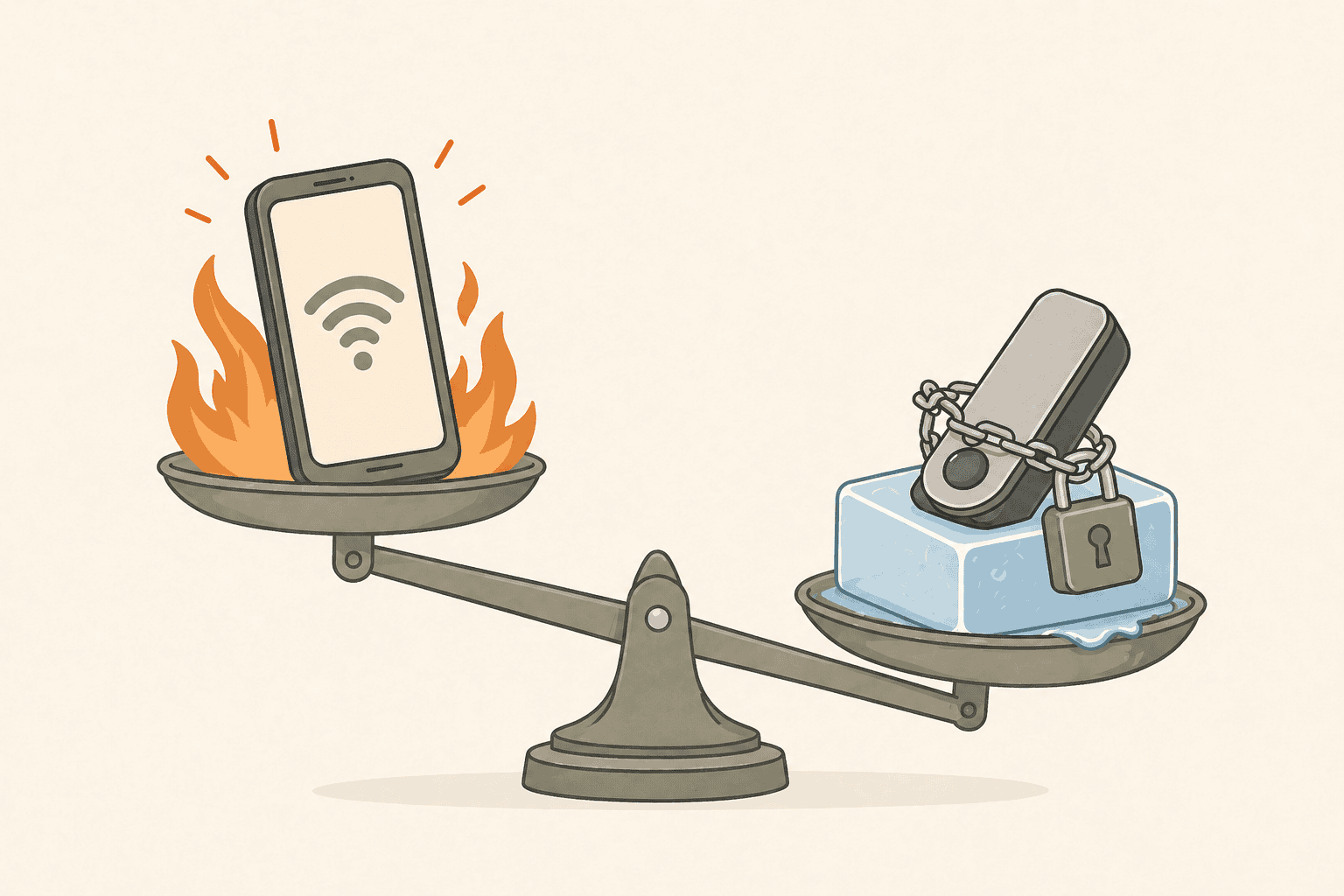
A wallet is a key manager, not a vault. The “hot vs cold” debate is really about one question: how many systems can touch your private key, and how exposed are those systems to the internet?
Hot Wallet: Connected, Convenient, Exposed
A hot wallet is any wallet whose private keys exist on a device connected to the internet. That includes exchange accounts, mobile wallets like MetaMask or Trust Wallet, browser extensions, and desktop applications.
The defining feature is not the software. It’s the network exposure. The moment your private key sits on a device that can talk to the outside world, every vulnerability of that device becomes a vulnerability of your funds — operating system bugs, browser exploits, malicious extensions, phishing sites, clipboard hijackers, infected downloads.
That doesn’t make hot wallets bad. It makes them tools with a specific risk profile.
What hot wallets are good for
- Active trading — you can’t trade if your keys are offline
- DeFi interaction — connecting to dApps requires a hot signing environment
- Small balances — amounts you’re willing to lose if the worst happens
- Frequent transactions — paying for things, sending small amounts to friends, gas-paying wallets for L2s
What they’re bad for
Anything you’d consider “savings.” If the amount on a hot wallet is large enough that losing it would change your life, the wallet is wrong for the job — not because hot wallets are inherently broken, but because the attack surface is too large for that risk profile.
⚠ Warning
Most crypto theft does not happen by breaking encryption. It happens by tricking the user — fake wallet popups, malicious token approvals, address poisoning, drainer scripts on compromised websites. A hot wallet exposes you to all of these. A cold wallet does not.
This is also where the venue you trust with custodial funds becomes a real decision — not all exchanges have equivalent security track records, proof-of-reserves practices, or insurance frameworks.
Cold Wallet: Offline, Inconvenient, Hard to Steal
A cold wallet stores private keys on a device that never connects to the internet. The two practical formats are hardware wallets (Ledger, Trezor, Coldcard) and air-gapped setups (offline computers, paper wallets, metal seed plates).
The mechanism is simple. To send a transaction, the cold device signs it offline using the private key, then exports the signed transaction to an online device that broadcasts it. The private key itself never leaves the cold environment.
That single design choice eliminates the entire category of remote attacks. A drainer script on a malicious website cannot extract a key that doesn’t exist on the connected device. Malware on your laptop cannot reach a key sitting in a hardware wallet’s secure element. A phishing site cannot approve a transaction without you physically pressing a button on the device.
✓ Why this works
Cold wallets don’t make your funds unhackable. They make remote, scalable attacks essentially impossible. An attacker now needs physical access to your device and your PIN and your seed phrase backup. That’s not a different level of security — it’s a different category.
The cost of cold storage
Cold wallets aren’t free, and the cost isn’t just the hardware. It’s friction. Every transaction requires the device. Every dApp interaction requires connecting it. Lost devices require recovering from a seed phrase you’d better have stored properly. There’s no “forgot password” flow.
That friction is the security feature. It’s also the reason most people who buy a hardware wallet eventually stop using it correctly — the inconvenience pushes them back to hot wallets, where the funds end up anyway.
The Direct Comparison
Here’s the honest side-by-side, without marketing language.
| Property | Hot Wallet | Cold Wallet |
|---|---|---|
| Internet connection | Always | Never (key stays offline) |
| Remote attack surface | Large — OS, browser, extensions, dApps | Effectively none |
| Physical attack risk | Low (no device to steal) | Real — device + PIN + seed |
| Setup time | Minutes | 30–60 minutes done properly |
| Transaction friction | Click and sign | Connect device, confirm on screen |
| Recovery | Depends (custodial: yes / non-custodial: seed only) | Seed phrase only |
| Cost | Free | One-time hardware purchase |
| Best use | Active funds, DeFi, small amounts | Long-term storage, large balances |
The Math: When Does a Hardware Wallet Pay for Itself?
This is the calculation almost nobody runs. Hardware wallets aren’t expensive in absolute terms — most quality models cost less than a single decent restaurant dinner. But the question isn’t whether you can afford one.
The question is: at what portfolio size does the expected loss from a hot-wallet compromise exceed the cost of the device?
Here’s the rough framework.
Expected annual loss (hot wallet) = P(compromise) × Portfolio value

Where P(compromise) for a typical hot wallet user is somewhere
between 0.5% and 3% per year, depending on:

  - How many dApps you connect to
  - Whether you click links from Discord/Telegram/X
  - Whether you reuse passwords
  - How careful you are with token approvals
  - Whether you use a dedicated wallet device

Conservative midpoint: 1% per year
Apply that to different portfolio sizes:
Assume a quality hardware wallet costs roughly $C
(a small one-time expense relative to the portfolio it protects).

Portfolio    Annual expected loss (1%)    Pays off vs. device
---------    -------------------------    ----------------------
$500         $5                           Doesn't pay off quickly
$2,000       $20                          Pays off in a few years
$8,000       $80                          Pays off in roughly a year
$25,000      $250                         Pays off in months
$100,000     $1,000                       Pays off in weeks
↯ Practical implication
If you have more than a few thousand dollars in crypto you’re not actively trading, the math on a hardware wallet stops being debatable. The break-even is fast and the downside of being wrong is catastrophic — you don’t get a second try after a drainer hits your hot wallet.
The Realistic Setup: Use Both
The hot vs cold framing makes it sound like a choice. It isn’t. Anyone with non-trivial holdings should be running both, with funds segregated by purpose.
The three-tier model
Tier 1 — Exchange (custodial hot)
Funds you’re actively trading. Capital at work, not capital at rest. The exchange holds the keys, which is its own risk category — but for active trading, the trade-off is acceptable. This is where your choice of exchange matters: proof of reserves, jurisdiction, security history.
Tier 2 — Self-custody hot wallet
A non-custodial wallet (MetaMask, Rabby, Phantom) for DeFi interaction, NFT activity, and short-term storage between trades. Keep this balance small — only what you need for the next few weeks of activity.
Tier 3 — Cold storage
A hardware wallet holding the majority of your crypto net worth. Funds you’d be devastated to lose. This wallet rarely connects to anything. You don’t sign random transactions with it. You don’t approve token contracts on it. It exists to receive funds and, occasionally, to send them.
✓ Why this works
Segregating funds by purpose limits damage. A drainer that empties your hot wallet does not touch your cold wallet. An exchange hack does not affect your self-custody. The goal isn’t perfect security — it’s containing any single failure to a fraction of your portfolio.
Choosing a Hardware Wallet
The hardware wallet market is small, competitive, and dominated by two brands that have been around long enough to matter: Ledger and Trezor. Both work. Both have flaws. Neither is a scam.
Ledger
Closed-source firmware running on a certified secure element chip. The closed-source part has historically generated controversy — most recently around the Ledger Recover service, which raised legitimate questions about whether private keys could ever be extracted from the device under specific conditions. Ledger’s response has been technical and largely satisfactory, but the trust question remains for some users.
What Ledger does well: broad coin support, polished software (Ledger Live), strong supply chain integrity, and a long track record without a customer-side key compromise tied to the device itself.
Recommended models:
- Ledger Nano S Plus — entry-level model, USB-only, lowest price point in the Ledger range
- Ledger Nano X — adds Bluetooth and larger memory; mid-tier price
Trezor
Open-source firmware. Lower-level chip without a certified secure element on the older models, though the Safe 3 and Safe 5 added one. The open-source argument is real: independent security researchers can audit every line of code that touches your keys. The trade-off is that some past vulnerabilities have been demonstrated in lab conditions on physical devices, though never exploited at scale in the wild.
What Trezor does well: transparency, strong open-source community, clean integration with third-party wallets (Electrum, Wasabi, Specter for Bitcoin users).
Recommended models:
- Trezor Safe 3 — secure element + open source; entry-tier price
- Trezor Safe 5 — touchscreen flagship; premium-tier price within the brand
⚠ Warning
Buy hardware wallets only from the manufacturer’s official website. Never from Amazon, eBay, or third-party resellers. Supply chain attacks — pre-initialized devices with attacker-controlled seed phrases — are a real, documented threat. The few dollars you might save isn’t worth the risk profile.
The Seed Phrase: The Real Single Point of Failure
People focus on the device. The device isn’t the vulnerability. The seed phrase is.
Your 12 or 24 word seed phrase is a complete backup of your wallet. Anyone who has it controls the funds, regardless of which device generated it. The hardware wallet protects the seed while it’s in the device. Once you write it down, the protection is whatever you do with the paper.
The mistakes that destroy people’s crypto, in rough order of frequency:
- Photographing the seed phrase — once it’s in a phone gallery or cloud backup, it’s compromised forever
- Storing it in a password manager — convenience that defeats the entire point of cold storage
- Typing it into any website “to verify your wallet” — this is always a phishing attempt; legitimate services never ask
- Single paper backup — fire, water, mice, moves, divorces; paper degrades faster than people expect
- Telling someone where it is — security ends where shared knowledge begins
↯ Practical implication
A hardware wallet without a properly stored seed backup is not a secure setup. It’s a bet that you’ll never lose the device. If you’re not willing to invest in a metal seed plate and store it somewhere physically secure, you haven’t actually finished setting up cold storage — you’ve just bought a device.
What to Avoid (Hard No List)
Some categories of “wallet” are bad ideas regardless of your situation. Skip them.
- Paper wallets generated on a connected device — defeats the purpose; the key existed on an internet-connected machine at creation
- Browser-based seed phrase generators — you have no way to verify the entropy source
- “Cloud-backed” hot wallets that store keys on a server — that’s just an exchange wearing a costume
- Hardware wallets from unknown brands — secure element chips and reproducible builds matter; off-brand devices can’t be trusted
- Splitting one seed phrase across multiple locations naively — without a proper Shamir or multisig setup, you’re often just creating multiple ways to lose half your phrase
The Bottom Line
Hot wallets are tools for capital in motion. Cold wallets are tools for capital at rest. Anyone who tells you only one of them is the right answer is either selling you something or hasn’t thought about it carefully.
For active funds — trading capital, DeFi positions, transaction balances — a combination of an exchange account and a self-custody hot wallet is appropriate. The friction of cold storage doesn’t fit the use case.
For long-term holdings — the part of your portfolio you’re not touching for months or years — a hardware wallet is not optional once your balance crosses a few thousand dollars. The math is straightforward, the products are mature, and the failure mode of getting it wrong is total and irreversible.
The right setup is rarely “one wallet.” It’s a system, with funds segregated by purpose and security calibrated to how each pile is being used. That’s not paranoia. It’s just basic risk management applied to a category of asset where mistakes don’t get refunded.
↯ Final reminder
The blockchain doesn’t care about your intentions, your backup plan, or how much you meant to set up that hardware wallet next week. It only cares whether the right private key signed the transaction. Treat the security setup as part of owning crypto, not as something you’ll do later.

Articles published under the Yieldova byline combine market data, primary sources, and hands-on trading experience. Every piece goes through the same standard: if we wouldn’t stake money on it, we don’t publish it.