
Last Updated on 30 April, 2026 by Yieldova
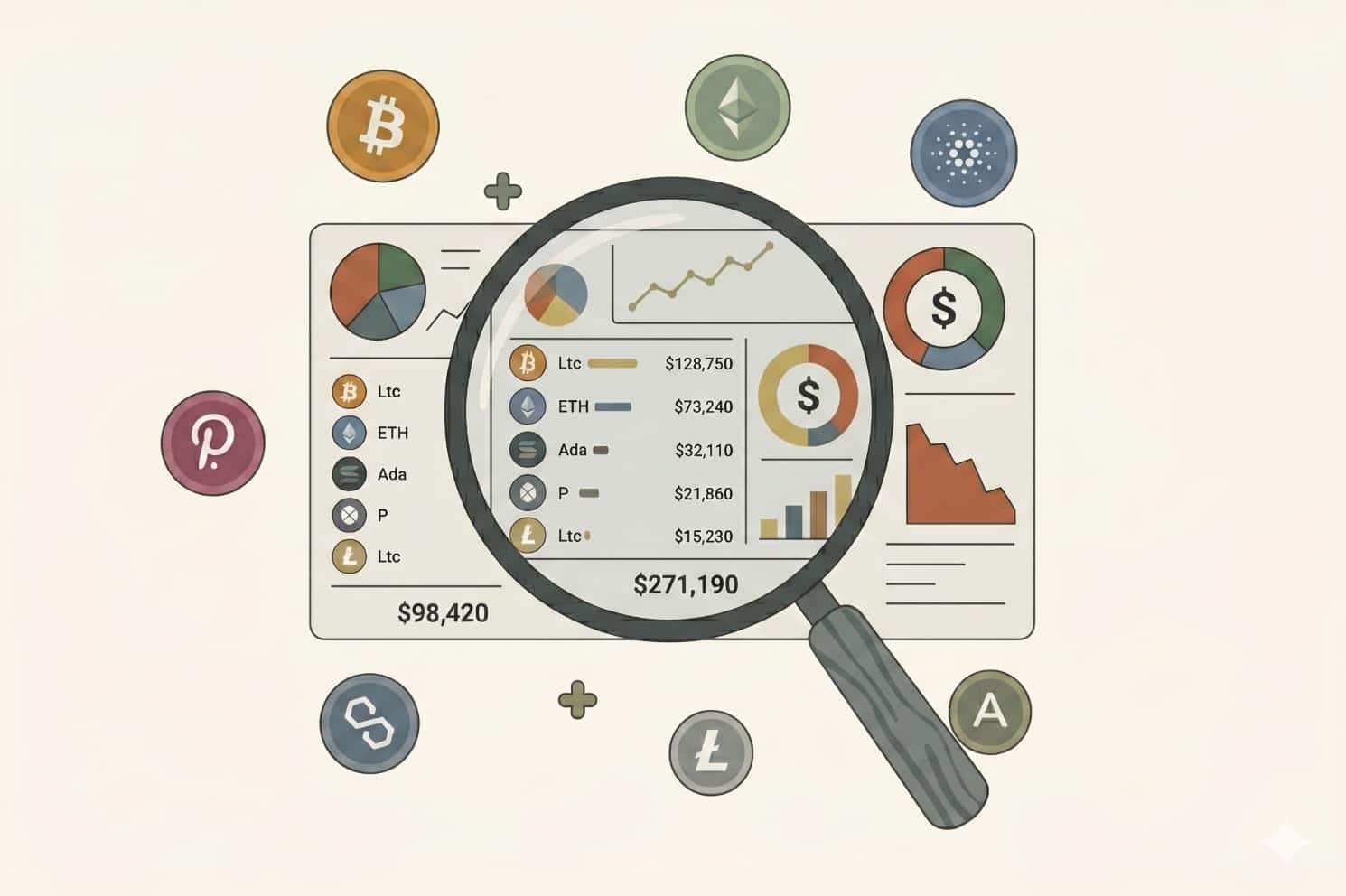
A crypto portfolio tracker should make managing your holdings easier. Most “best crypto portfolio tracker” articles are ranked lists where the top spot goes to whoever paid the most affiliate commission. This is not that. It’s the framework I use to evaluate trackers — what to actually look at, what to ignore, and where every option quietly falls short.
Quick Verdict
If you only have 30 seconds:
- Mostly on centralized exchanges, want a clean dashboard: Delta is the cleanest option for purely watching your portfolio across CEXes.
- Mix of CEX + DeFi + NFTs in one view: CoinStats has the broadest coverage as of 2026.
- Pure DeFi, EVM-focused: Zerion or DeBank beat any general-purpose tool for on-chain depth.
- Tax reporting is the actual problem: CoinTracker or Koinly are built for this; performance trackers will frustrate you.
- Privacy matters and you don’t trust SaaS with financial data: Rotki is open-source and runs locally.
ℹ Quick answer
Choosing a crypto portfolio tracker comes down to three questions: where are your assets (CEX, DeFi, multi-chain, NFTs?), how complex is your tax situation, and how much accuracy do you actually need? Get those right and the brand barely matters. Get them wrong and the most “popular” tracker will fail you.
Why You Probably Need One (And Why Spreadsheets Stopped Working)
If your entire crypto exposure is 0.5 BTC sitting on Coinbase, you don’t need a tracker. The exchange dashboard is enough. The math is trivial: how much you bought, how much it’s worth now, done.
The case for a tracker starts when any of these become true:
- You hold assets on more than two exchanges or wallets
- You interact with DeFi protocols (staking, LP positions, lending)
- You’ve held long enough to need cost-basis tracking for tax purposes
- You move funds between addresses (each transfer is a transaction your tax authority might need to see)
- You hold tokens that aren’t on the major exchanges
At that point, manual tracking in a spreadsheet stops scaling. Not because the math is hard — it isn’t — but because the data input becomes a part-time job. Every transaction across every chain has to be entered, with timestamps, fees, and counterparty addresses. A single missed transaction breaks the entire cost-basis chain.
↯ Practical implication
The point of a portfolio tracker isn’t to make you feel organized. It’s to absorb the data-entry tax that crypto’s fragmented infrastructure creates. If a tracker doesn’t actually save you time, it’s failing at its only real job.
Put it differently: most people don’t have a tracking problem — they have a data fragmentation problem. The tracker is the consequence, not the cause.
The Two Categories Nobody Separates Properly
Most articles lump every “tracker” together. They aren’t the same product. There are two distinct categories with different goals.
Performance trackers
These exist to answer one question: what’s my portfolio worth right now, and how is it doing?
They focus on real-time valuation, P&L, asset allocation, and price alerts. Tax features are secondary or absent. The strength is breadth of integrations and live data — connecting to many exchanges, wallets, and chains so the dashboard reflects reality.
Examples: Delta, CoinStats, Zerion, DeBank.
Tax-aware trackers
These exist to answer a different question: what is my cost basis, what gains have I realized, and what do I owe?
They focus on transaction history, lot accounting (FIFO, LIFO, HIFO), and jurisdiction-specific tax reports. Real-time portfolio value matters less. The strength is accuracy across complex transaction types — DeFi swaps, staking rewards, airdrops, hard forks, NFT trades.
Examples: CoinTracker, Koinly, Rotki.
✓ Why this matters
These two categories use the same word (“tracker”) but solve different problems. A performance tracker that “supports tax reports” usually means it exports a CSV. A tax-aware tracker is built around the transaction ledger from day one. Asking the wrong tool to do the other job is where most users end up frustrated.
And the cost of choosing wrong isn’t just frustration. The wrong tracker produces misleading P&L numbers you’ll act on, or incorrect tax reports you’ll file. Both are real money mistakes, not theoretical ones.
Some tools straddle both — CoinStats and CoinTracker have moved in this direction — but they generally do one thing better than the other. Pick based on which job is actually your bottleneck.
The Real Evaluation Criteria
Here’s what to actually look at when comparing trackers, in rough order of importance.
Integration coverage (the only thing that breaks the deal)
If a tracker doesn’t connect to where your assets are, nothing else matters. This is non-negotiable and the first thing to check before reading a single review.
Build a list of every venue you use:
- Centralized exchanges (Binance, Coinbase, Kraken, OKX, Bybit, etc.)
- Self-custody wallets (MetaMask, Phantom, Rabby, hardware wallets)
- Blockchains where you hold assets (Ethereum, Solana, Bitcoin, BSC, Polygon, Arbitrum, Base, etc.)
- DeFi protocols you actively use (Aave, Uniswap, Curve, Lido, etc.)
- NFT marketplaces, if relevant
Then check the tracker’s documentation, not its homepage marketing. Trackers commonly advertise “300+ integrations” but the long tail is often broken, deprecated, or read-only in ways that miss DeFi positions. If you haven’t picked your primary exchange yet, our guide on choosing a crypto exchange covers what actually matters before you commit.
⚠ Warning
“Supports Ethereum” doesn’t mean “tracks every protocol on Ethereum correctly.” A tracker can connect to your wallet address and still misread your Aave deposit as a regular ERC-20 balance, or miss your Uniswap LP position entirely. Test with your actual wallet before committing to any paid tier.
API connection method
Trackers connect to your exchange accounts in one of two ways:
Read-only API keys — you generate API keys with no withdrawal permissions and paste them into the tracker. The tracker can read your balance and transaction history but cannot move funds. This is the safer option.
OAuth-style logins — you authenticate through a third-party service (Plaid, Vezgo) that handles credentials. Convenient, but adds another party that has access to your data.
For self-custody wallets, all trackers use public read-only access — you give them your wallet address (not your seed phrase or private key, ever), and they read on-chain data. This is genuinely safe; the address is public information by design.
⚠ Warning
No legitimate tracker ever needs your seed phrase, private keys, or password. If a “tracker” asks for any of these, it’s a scam. Wallet addresses are public; everything beyond that is unnecessary access. We covered this in more depth in our guide to hot vs cold wallets.
Transaction handling depth
This is where trackers separate. Anyone can show you “you have 1.2 ETH worth $3,400.” The hard part is correctly classifying the dozens of transaction types crypto produces:
- Staking rewards (income? capital gain? depends on jurisdiction)
- Liquidity pool entries and exits (cost basis allocation)
- Yield farming claims (often taxed as income at receipt)
- Airdrops (taxable at fair market value at receipt in most countries)
- Hard forks (creating new tokens you didn’t buy)
- NFT mints, royalties, and trades
- Gas fees (sometimes deductible, sometimes part of cost basis)
- Wrapped tokens (transfer or taxable event, depends on jurisdiction)
A performance tracker like Delta will show all of these as “balance changes” without classifying them. A tax-aware tracker like CoinTracker or Koinly attempts to classify each one correctly — and gets it wrong often enough that you’ll need to review and reclassify manually. The classification problem gets worse if you trade derivatives — our piece on spot vs perpetuals vs futures covers why those products produce transaction types most trackers handle poorly.
Cost basis methodology
If you hold the same coin across multiple buys, when you sell, which “lot” did you sell? FIFO (first-in-first-out) is the default in many jurisdictions. LIFO (last-in-first-out) and HIFO (highest-in-first-out) can produce dramatically different tax outcomes.
A serious tracker lets you choose the methodology, see the impact across the full tax year, and switch between them for comparison. A weak one applies one method silently and presents you with a number.
Pricing model alignment
Pricing in this space is fragmented and worth understanding before you sign up. Trackers charge by:
- Number of transactions — common for tax-aware trackers (Koinly, CoinTracker, CoinLedger)
- Portfolio value — used by some performance trackers
- Flat tier — Delta Pro and CoinStats both offer flat-rate annual subscriptions at affordable price points
- Free with add-ons — Zerion, DeBank are free for basic use, charge for premium features
- One-time purchase / open source — Rotki is the only major option here
The transaction-volume model punishes active traders. The portfolio-value model punishes long-term holders. The flat-tier model is friendliest but often comes with lower coverage. If you’re looking for a free crypto portfolio tracker to start with, Zerion, DeBank, and the free tiers of Delta and CoinStats cover most basic use cases without paying anything — the upgrade decision can wait until you’ve outgrown the free version.
Privacy and data handling
Most trackers are SaaS — your wallet addresses, exchange API keys, and transaction history sit on their servers. That’s a real privacy surface. If those servers are breached, the attacker gets a map of your entire crypto life.
Self-hosted alternatives like Rotki run locally on your machine. The trade-off is convenience: no mobile app, more setup, no automatic updates.
↯ Practical implication
For most users, the privacy trade-off of cloud-based trackers is acceptable in exchange for the convenience. If you’re a high-net-worth crypto holder or simply privacy-conscious, the local-first model of Rotki is the only honest option among major tools.
The Major Trackers, Honestly
Brief, honest summaries of what each major tracker does well and where it falls short. Not a ranking — different tools for different jobs.
| Tracker | Best for | Main weakness | Pricing |
|---|---|---|---|
| CoinStats | All-in-one CEX + DeFi + NFT view | Pricing creeps higher than competitors at premium tiers | Free / paid tiers |
| Delta | Clean UX, multi-asset (crypto + stocks) | DeFi coverage shallower than specialists | Free / Pro tier |
| Zerion | EVM DeFi positions, native swaps | Weak on Bitcoin, non-EVM chains, CEX integration | Free / paid tiers |
| DeBank | Deep on-chain DeFi visibility, social features | Not designed for non-DeFi users; no real CEX support | Free |
| CoinTracker | Tax reporting, especially for US filers | Performance dashboard is secondary; pricing tied to transaction volume | Free tier limited; paid tiers scale with tx |
| Koinly | Multi-jurisdiction tax reports, broad integration | UI less polished than CoinTracker; same volume-based pricing | Free preview; paid for reports |
| Rotki | Privacy, local-first, open source | Setup friction; no mobile; smaller integration list | Free / Premium tier |
Top four rows are performance trackers; bottom three are tax-aware. The “best” one depends entirely on what you’re trying to solve.
Who Should Use Which Tracker
The criteria above map cleanly to user archetypes. Find yourself in one of these and the choice becomes obvious.
If you’re mostly on CEXes and want a clean portfolio dashboard
You want Delta. It was built for exactly this use case — connect a few exchanges, watch your portfolio, set price alerts, get a clean breakdown of allocation. As a crypto portfolio tracker app, Delta is one of the most polished mobile-first options on the market. Its acquisition by eToro in 2019 means it’s also unusually solid for tracking traditional assets (stocks, ETFs) in the same view, which most crypto-only trackers can’t match.
The weakness: anything beyond CEX-and-major-wallet tracking gets thin. If half your portfolio lives in DeFi, Delta will undercount it.
CEX-focused dashboard
Delta is the cleanest option for purely watching your portfolio
Multi-asset support (crypto + stocks + ETFs), polished mobile UX, and a free tier that’s actually useful. Pro tier adds advanced features at an affordable annual price.
If you have assets across CEX, DeFi, and NFTs
CoinStats has the broadest coverage we’ve found in 2026 — over 300 exchange and wallet integrations, 100+ blockchains, and 1,000+ DeFi protocols. It’s the closest thing to a one-stop dashboard for someone whose portfolio spans every category of crypto activity.
The weakness: pricing climbs quickly past the free tier, and the all-in-one approach means it’s not the best at any single category — Zerion will read your DeFi positions more accurately, CoinTracker will produce better tax reports — but it’s the only tool that gets within reach of all of them.
Multi-category coverage
CoinStats is the broadest single tracker in 2026
If your portfolio spans CEXes, multiple chains, DeFi protocols, and NFTs, CoinStats covers more ground in one tool than any alternative.
If you live on-chain (DeFi-first)
If 80% of your activity is DeFi on Ethereum, L2s, and other EVM chains, a general-purpose tracker will frustrate you. Zerion and DeBank are both built specifically for on-chain users and read positions more accurately — Aave deposits are correctly identified as Aave deposits, Uniswap LP positions show their actual underlying composition, etc.
Zerion leans toward retail UX and includes built-in swaps. DeBank leans toward power users with deeper protocol coverage and social/leaderboard features. Both are free for core use.
If your real problem is taxes
Switch categories. Performance trackers will not solve your tax problem, no matter how many “tax features” they add. You want a purpose-built tax-aware tracker.
CoinTracker is the standard for US filers — direct TurboTax integration, IRS-formatted reports, strong customer support. Koinly covers more jurisdictions (UK, Canada, Australia, EU countries) and is generally cheaper at equivalent transaction tiers.
Both charge based on transaction volume, which matters: a DeFi power user with thousands of swaps per year will pay more than a buy-and-hold investor with 20 transactions.
Tax reporting
CoinTracker for US filers, Koinly for everyone else
CoinTracker has the tightest US/IRS integration. Koinly covers more jurisdictions globally and is typically cheaper at equivalent transaction volumes.
If privacy matters more than convenience
Cloud-based trackers all share the same architectural reality: your wallet addresses, API keys, and transaction history sit on their servers. For most users, that trade-off is acceptable. For privacy-conscious holders, high-net-worth investors, or anyone who simply doesn’t want their financial map sitting on a third-party server, Rotki is the only major option that runs locally.
Rotki is open-source, runs on your own machine, and never sends your data anywhere. The trade-off is real — no mobile app, more setup friction, smaller integration list, no automatic background syncing — but if privacy is the priority, no SaaS competitor can match it architecturally.
Decision Matrix
Condensed to one table:
| Your situation | Best primary | Strong alternative |
|---|---|---|
| Mostly CEXes, want clean dashboard | Delta | CoinStats |
| Mix of CEX + DeFi + NFTs | CoinStats | Zerion + Delta combo |
| DeFi-first, EVM chains | Zerion | DeBank |
| Tax reporting (US) | CoinTracker | Koinly |
| Tax reporting (UK / EU / non-US) | Koinly | CoinTracker |
| Privacy-first / self-hosted | Rotki | (no SaaS alternative matches) |
| Active trader on multiple exchanges | CoinStats | Delta for view + Koinly for tax |
| NFT-heavy collector | CoinStats | Zerion for floor-price tracking |
The Limitations Nobody Mentions
Every tracker fails in similar ways. The differences are which failures it admits to and which it papers over.
Cost basis is fundamentally an estimate. If you bought 0.5 BTC on Binance in 2021, transferred it to a wallet, lost the original transaction record, and now want to calculate your gain — your tracker is guessing. It picks a price (usually mid-day average, sometimes the closing price) and calls it your cost basis. That number is plausible, not correct. The IRS or your local tax authority generally accepts it because alternatives don’t exist, but understand what’s actually happening.
DeFi protocols change faster than trackers update. A protocol launches a new staking module on Tuesday; your tracker probably doesn’t recognize it until weeks or months later. During that gap, your “balance” looks wrong. Manual entry can fix this, but defeats the point of automation.
Token contract changes break historical data. When tokens migrate contracts (V1 to V2, governance upgrades), trackers sometimes lose the connection to your historical position. Suddenly your 2021 cost basis is gone. Some tools handle this gracefully; most don’t.
NFT valuation is fiction. Whatever number your tracker shows for your NFT portfolio is mostly imaginary — based on floor prices, last sales, or oracle estimates that move 30% on weekends with no actual liquidity behind them. Treat NFT valuations as directional, never as wealth statements.
⚠ Critical reminder
No tracker is a source of truth — it’s a model of the truth. The exchange ledger, the on-chain transaction record, and your tax filing all take precedence over whatever the dashboard shows. Reconcile periodically; don’t trust blindly.
What to Do First
If you’re starting from zero, here’s the practical order:
- List every venue where you have crypto. Exchanges, wallets, hardware wallets, lending platforms, staked positions. All of them.
- Identify your real problem. Performance dashboard? Tax reporting? DeFi visibility? Privacy? The answer determines the category.
- Pick one tracker from the right category. Not three. Most users end up with one performance tracker and (during tax season) one tax-aware tracker. That’s fine. More than that becomes its own data-entry problem.
- Test with the free tier first. Connect your largest wallet or biggest exchange. See if balances match. If they don’t, the paid tier won’t fix it.
- Verify against the source. Cross-check your tracker’s numbers against your exchange dashboards and on-chain explorers monthly. Trackers drift. (If you’re still deciding which exchanges to use as your sources of truth, our measured comparison of 7 crypto exchanges looked at the actual cost of trading on each.)
The Bottom Line
The “best crypto portfolio tracker” doesn’t exist. There’s the best one for your specific situation, and there’s everything else.
If you do nothing else, separate the two questions: what’s my portfolio worth right now is a different problem from what do I owe in taxes. Tools optimized for one tend to be mediocre at the other. Treat them as separate purchases — performance dashboard for daily use, tax-aware tracker once a year — and the choices become obvious.
And remember the one thing every “best of” article forgets to mention: a tracker is software written by humans who can’t predict every edge case in a market that mints new edge cases weekly. Your tracker will be wrong about something at some point. Build the habit of reconciling against the source — exchange dashboards, block explorers, your own records — before that wrongness becomes your tax filing.
↯ Final reminder
A portfolio tracker is a tool, not a source of truth. The exchange ledger and the blockchain are the source of truth — your tracker is a useful summary of them. When the two disagree, the source wins. Always.

I’ve spent years trading crypto futures and building automated arbitrage systems across exchanges. I started Yieldova to share what, in my opinion, actually works in live markets. I’ve had losing streaks, blown strategies, and a few wins worth writing about. Everything here is based on real experience.