
Last Updated on 30 April, 2026 by Yieldova
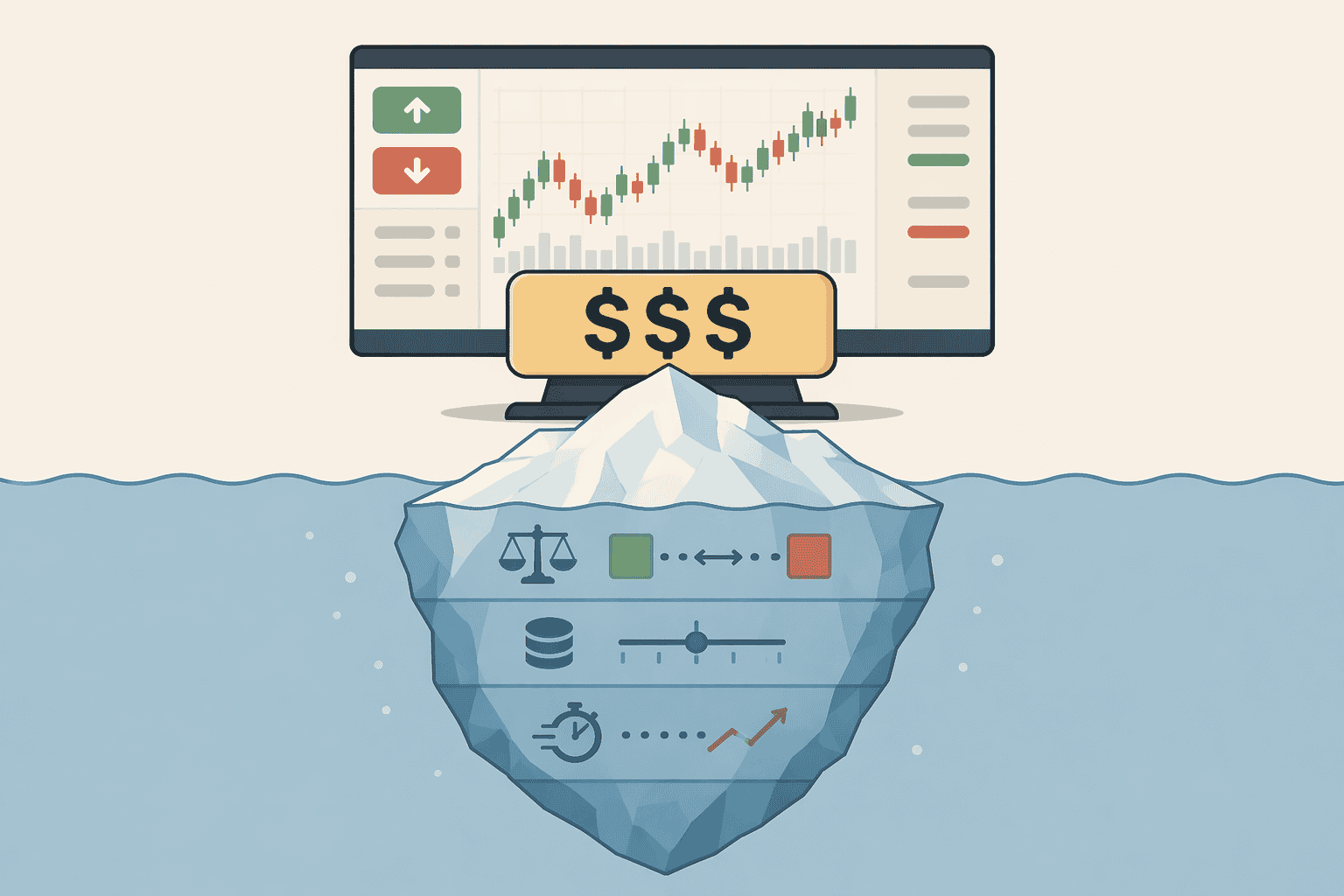
Every broker advertises “$0 commissions.” Every broker is also making money from you — just not where you’re looking. Real broker costs have four components, and only one of them shows up on the fee schedule.
One number to set the stakes: two traders holding the same $100,000 margin position overnight pay roughly $5,300 per year at Interactive Brokers and roughly $11,400 per year at Schwab. Same position, same risk, same tax treatment — a $6,000 annual gap that never shows up on any fee schedule. The math behind that number, and the three other costs brokers compete on, is below.
Quick Verdict
The cheapest broker depends on how you trade:
- If you use margin: Interactive Brokers is the lowest-rate broker in the industry by a wide margin.
- If you trade options in size: Tastytrade‘s $10-per-leg cap dominates multi-leg strategies.
- If you don’t use margin and want a polished platform: Charles Schwab with thinkorswim.
- If you trade futures at high volume or run automated strategies: TradeStation‘s tiered pricing plus EasyLanguage.
If You’re Picking a Broker by Commissions, You’re Optimizing the Wrong Number
When a broker charges $0 per trade, they are not giving you anything for free. They are choosing where to hide the cost. It might be in the margin rate they charge on overnight positions. It might be in the execution venue they route your order to. It might be in the spread on the currency conversion when you buy a foreign stock. But it is always there.
The problem with most broker comparisons is that they show you the visible number — the commission — and ignore everything else. A trader comparing two “commission-free” brokers might reasonably assume both cost the same. In practice, one can cost thousands of dollars more per year than the other.
This article doesn’t give you a ranking. Rankings assume everyone has the same trading profile, which isn’t true. Instead, it gives you the math, the data, and a tool that runs the calculation for your specific situation across four brokers: Interactive Brokers, Charles Schwab, Tastytrade, and TradeStation.
ℹ Who this is for
Active traders, options traders, and anyone using margin. If you buy an index fund once a month and hold forever, the broker barely matters. If you trade frequently, hold leveraged positions overnight, or trade options in size, the broker choice can cost or save you thousands per year.
The Four Components of Real Trading Cost
Every trade you make carries four distinct costs. Brokers compete on the first one and profit on the other three.
1. Commissions. The explicit per-trade or per-contract charge. This is the number everyone quotes, and it’s typically the smallest of the four for active traders. Most US brokers charge $0 on stocks and ETFs. Options run from $0.60 to $1.00 per contract. Futures run from $1 to $3 per contract including exchange fees.
2. Margin interest. If you hold leveraged positions overnight, you pay annual interest on the borrowed amount. This is where the largest cost difference between brokers lives. Interactive Brokers charges around 5.3% on a $100,000 loan. Schwab charges around 11.4% on the same loan. That’s a $6,000 annual gap on an otherwise identical position.
3. Option and futures fees. Beyond the per-contract commission, brokers differ in how they structure fees for derivatives. Tastytrade caps options commissions at $10 per leg regardless of size — a 50-contract position costs the same as a 10-contract position. Schwab has no cap. For block traders, the difference is substantial.
4. Execution shortfall (payment for order flow). When a broker offers $0 commissions, they’re often being paid by a market maker to route your orders. The market maker makes money on the spread. You pay through slightly worse fill prices — measurable in basis points, invisible on your statement. Interactive Brokers Pro doesn’t accept payment for order flow. Schwab, Tastytrade, and TradeStation do.
↯ The execution cost is real but estimated
Execution shortfall from payment for order flow can be measured in aggregate from SEC Rule 606 filings and academic studies, but it varies by order type, symbol, and market conditions. The calculator applies a conservative estimate of 2 basis points on the notional value of stock trades for brokers that accept payment for order flow. It applies to market orders. Limit orders typically execute at the national best bid or offer and are unaffected.
Why Static Tables Don’t Work
The standard broker comparison article shows you a table with commissions, margin rates, and feature lists. It then tells you which broker is “best.” That recommendation is meaningless without context, because the right broker depends entirely on how you trade.
Consider three traders with identical $50,000 accounts:
Trader A buys and holds long-term positions. Makes five trades per year, never uses margin. For this trader, broker choice barely affects anything. Any of the four brokers cost roughly the same because commissions are near zero on stocks and there’s no margin interest to pay.
Trader B trades options actively — 30 multi-leg spreads per month, 10 contracts per leg. For this trader, Tastytrade’s $10-per-leg cap saves hundreds per year versus Schwab’s uncapped $0.65-per-contract structure. The broker choice suddenly matters.
Trader C holds $30,000 in leveraged positions overnight. For this trader, the margin rate difference dominates every other cost. Interactive Brokers saves them roughly $1,800 per year versus Schwab on margin interest alone — enough to fund a separate account.
Same capital, three completely different optimal brokers. A static table can’t tell you which one applies to you. The math below can.
How to Read the Results
The calculator ranks the four brokers by estimated total annual cost based on your inputs. The breakdown below each broker shows where that cost comes from — commissions, option fees, futures fees, margin interest, and execution shortfall from payment for order flow.
The cheapest broker for your profile is not necessarily the right broker for your profile. Cost is one input among several. Platform quality, API access, order routing control, international market access, and tax handling also matter. But cost is the one input where the difference between brokers is often measurable in thousands of dollars per year — and it’s the one most people ignore.
When Each Broker Wins
Running the calculator across common trader profiles shows clear patterns. These aren’t rankings — they’re situations where each broker has a genuine mathematical advantage.
Interactive Brokers (IBKR Pro) wins when margin is involved. The margin rate is the lowest in the industry by a wide margin — roughly 5 to 6 percentage points below Schwab, TradeStation, and Tastytrade on comparable balances. For any trader holding leveraged positions overnight, this advantage compounds fast. IBKR Pro also doesn’t accept payment for order flow, which matters more for active traders executing market orders at size. The trade-off is a steeper learning curve and a platform that assumes you know what you’re doing.
If IBKR fits your profile
Lowest margin rates in the industry, no payment for order flow
Best fit for leveraged overnight positions and market-order-heavy strategies.
Schwab wins when you don’t use margin and don’t trade options in size. Zero commissions on stocks and ETFs, per-contract options pricing that’s competitive for small positions, and a platform that many traders find easier to navigate than IBKR. The margin rate is uncompetitive, so any trader using leverage overnight should look elsewhere. Schwab does accept payment for order flow, so the execution cost shows up in the calculator for active stock traders.
If Schwab fits your profile
The most polished retail platform, with thinkorswim access
Best fit for cash accounts without overnight leverage.
Tastytrade wins when you trade options in blocks. The $10-per-leg cap is the key feature: a 50-contract iron condor costs $10 per leg to open and $0 to close. At Schwab, the same position costs $32.50 per leg to open with no cap. For options traders running multi-leg strategies at size, this difference dominates the total cost. Margin rates are not competitive, so Tastytrade is not the right choice for leverage-heavy strategies.
If Tastytrade fits your profile
$10-per-leg cap makes multi-leg options viable at any scale
Best fit for block options traders running spreads at size.
TradeStation wins for active futures traders with high volume. The tiered commission structure rewards frequency — high-volume futures traders can reach per-contract rates below Schwab or Tastytrade. The platform is built with algorithmic trading in mind, including EasyLanguage for strategy automation. For traders below 1,000 contracts per month, the tier advantage doesn’t apply and other brokers may be cheaper.
If TradeStation fits your profile
Tiered commissions and EasyLanguage for strategy automation
Best fit for high-volume futures traders and systematic strategies.
ℹ The case for multiple accounts
Nothing requires you to use one broker. Traders with distinct strategies across asset classes often run multiple accounts: Interactive Brokers for equities on margin, Tastytrade for options blocks, TradeStation for futures automation. The overhead is real (more statements, more tax forms) but the cost savings can justify it for high-volume traders.
Decision Matrix
Condensed to one table:
| Your situation | Best broker |
|---|---|
| Uses margin on overnight positions | Interactive Brokers |
| Trades options in blocks (multi-leg, size) | Tastytrade |
| Cash account, no leverage, wants polished platform | Charles Schwab |
| High-volume futures / automated strategies | TradeStation |
| Market-order-heavy strategy (no payment for order flow) | Interactive Brokers |
| International equities or FX conversion needs | Interactive Brokers |
What the Calculator Doesn’t Capture
The calculator estimates the four largest and most consistent cost components. It intentionally doesn’t attempt to quantify several real costs that vary too much to average meaningfully.
Spread cost on illiquid stocks. The bid-ask spread on Apple or Microsoft is negligible. On a small-cap stock trading a few thousand shares per day, it can be substantial. This cost depends on what you trade, not how, and is largely independent of broker choice — all four brokers access the same underlying market.
Slippage on fast markets. Market orders in volatile conditions can fill at prices noticeably different from the quote when you clicked. This varies by broker infrastructure, but it’s difficult to quantify without live testing. It tends to be worst at brokers using payment for order flow and best at brokers with direct market access, which aligns with the execution shortfall estimate the calculator already includes.
Stock borrow fees on short positions. If you short a hard-to-borrow name, the daily financing cost can be significant. This varies constantly by symbol and is impossible to generalize.
FX conversion fees on non-USD assets. Trading European or Asian stocks in a USD account means converting currency. Interactive Brokers is the clear leader here — spreads under 2 basis points. Schwab is competitive. For traders focused on US markets, this doesn’t apply.
Inactivity fees, transfer fees, and wire fees. These matter if they apply to you. None of the four brokers charge inactivity fees on standard accounts as of 2026. Outgoing transfer fees run $75 at all four. Wire fees run $25 to $45.
Methodology and Sources
All commission and margin data comes from each broker’s published fee schedule, verified as of April 2026. Execution shortfall estimates are based on SEC Rule 606(a) quarterly filings and peer-reviewed academic research on retail order routing costs. The estimate of 2 basis points is deliberately conservative — some studies find lower, some find higher, and the true number varies by order type and market conditions.
Margin rates are reviewed quarterly because they move with Federal Reserve benchmark rate changes. Commissions, option fees, and other structural costs are reviewed annually. The last review date is displayed at the bottom of the calculator.
The four brokers in the calculator were chosen because they serve the active and algorithmic trading audience this site targets. eToro is not included because its cost structure — built around CFD spreads and overnight financing outside the US, zero commissions with payment for order flow inside the US — is different enough that a direct comparison would distort more than it clarifies.
⚠ Past data does not predict future fees
Brokers change fee schedules, margin rates adjust with central bank policy, and new pricing tiers appear regularly. The numbers in this calculator are accurate as of the verification date shown. Before opening an account based on a calculation here, verify the current fee schedule directly on the broker’s website.
Open an Account With the Right Broker
If the calculator pointed to a clear winner for your profile, the application takes about 15 minutes and approval usually comes within a business day or two.
If you’re looking for the lowest margin rates in the industry and an execution model without payment for order flow, open an Interactive Brokers account.
If you won’t hold leveraged positions overnight and want the most polished retail platform with access to thinkorswim, open a Charles Schwab account.
If you trade options in size and want the $10-per-leg cap that makes multi-leg strategies viable at any scale, open a Tastytrade account.
If you trade futures actively or run automated strategies and need EasyLanguage with volume-tiered pricing, open a TradeStation account.
ℹ Disclosure
Some of the broker links on this page are affiliate links. If you open an account through them, Yieldova receives a referral payment from the broker at no cost to you. This does not influence the calculator’s math or the analysis in this article — the numbers are the same whether you use the affiliate link or find the broker directly. Our methodology and sources are documented openly so you can verify any claim.
What to Do With This
Run the calculator for your actual trading profile. Not the profile you aspire to, not the profile you think you should have — the one you actually have, based on last year’s activity. If you don’t know, log into your current broker and count.
If the calculator shows that switching brokers would save you meaningful money, that’s useful information. But switching brokers has friction costs that aren’t in the calculator: learning a new platform, migrating positions, updating automated systems, filing additional tax forms. The savings need to be large enough to justify those costs. For traders using margin heavily or trading options in size, they often are. For casual traders, they usually aren’t.
The larger point is that “commission-free” is not the same as “free.” If you accept that premise, the rest of the broker choice is just math — and math is the one thing that doesn’t lie to you.
Related: How to Choose a Broker: What Active Traders Actually Need to Evaluate — the full framework for evaluating brokers beyond cost. Also: Why Trading Strategies That Work in Backtest Fail in Live Markets — how execution costs (the same ones calculated here) destroy theoretical returns.

I’ve spent years trading crypto futures and building automated arbitrage systems across exchanges. I started Yieldova to share what, in my opinion, actually works in live markets. I’ve had losing streaks, blown strategies, and a few wins worth writing about. Everything here is based on real experience.