
Last Updated on 30 April, 2026 by Yieldova
Most traders spend months finding the right strategy and five minutes deciding how much to risk per trade. That’s the most expensive mistake in this business.
The Part of Trading Nobody Talks About
Ask a trader what they’re working on and they’ll tell you about their entry signals, their indicators, their backtested edge. Ask them how they size their positions and you’ll usually get a vague answer — “I risk about 2%” or “it depends” or something that amounts to intuition dressed up as a system.
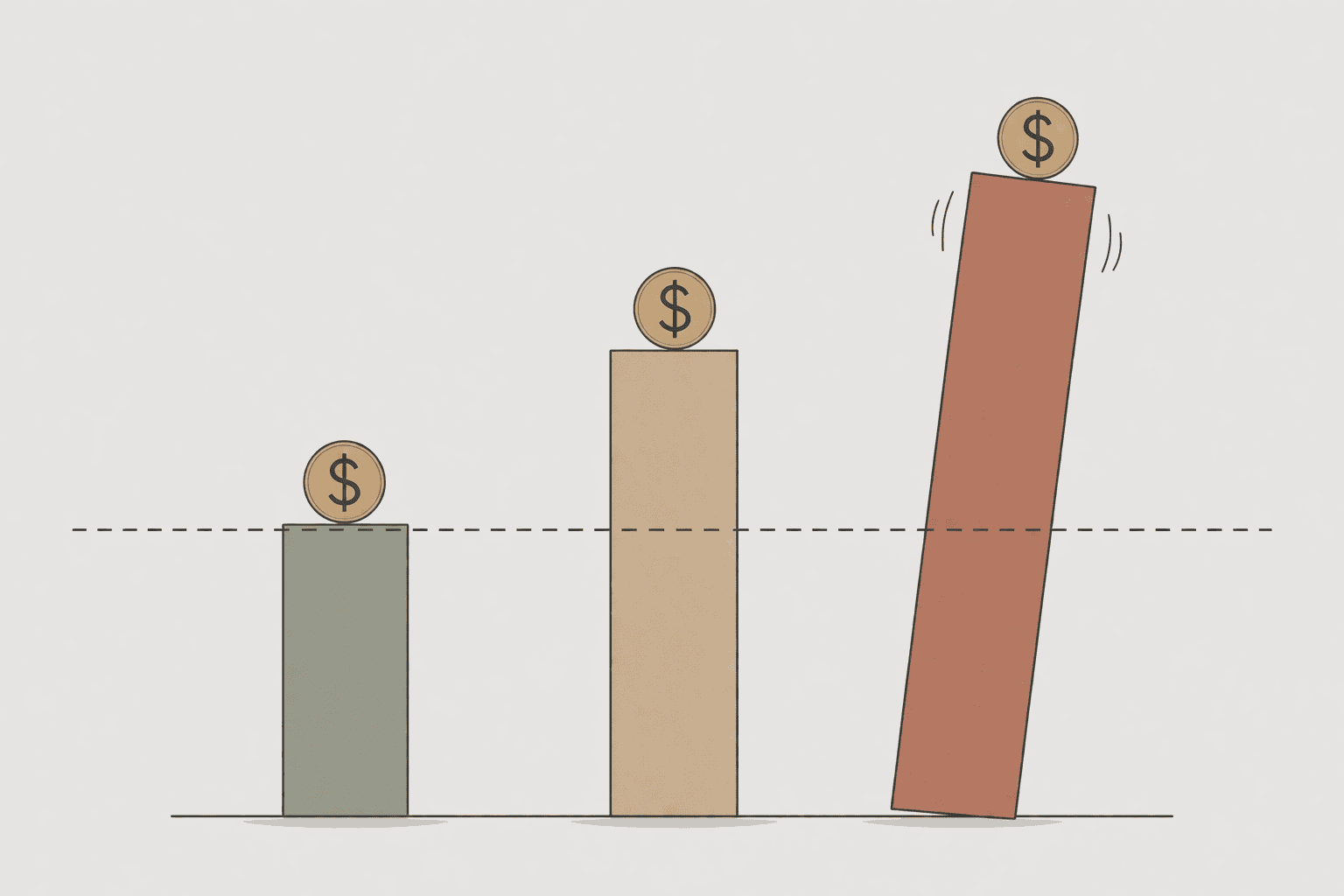
Position sizing is the most underleveraged variable in trading. It doesn’t show up in strategy backtests the way entry signals do. It doesn’t generate content on YouTube. It doesn’t have a compelling visual. But it’s the variable that determines whether a profitable strategy actually makes you money — or whether the same strategy, with the wrong sizing, slowly destroys your capital through drawdowns you can’t psychologically survive.
A strategy with a genuine edge can be made unprofitable by poor position sizing. A mediocre strategy can be made catastrophic by aggressive sizing. The math is unambiguous — and most traders never look at it seriously.
Why Position Sizing Matters More Than Entry Signals
Consider two traders running the exact same strategy: 40% win rate, average winner 2x the average loser. On paper, this is a profitable setup — the expected value per trade is positive.
The expected value per trade is calculated as:
EV = (Win rate × Average win) − (Loss rate × Average loss)
EV = (0.40 × 2) − (0.60 × 1)
EV = 0.80 − 0.60
EV = +0.20 per unit risked
Positive expected value. The strategy works. Now watch what happens with different position sizing.
Trader A risks 2% of capital per trade. After a losing streak of 10 consecutive losses — which at a 60% loss rate is not unusual, it has roughly a 0.6% probability of occurring, meaning it will happen multiple times over a multi-year trading career — they’ve lost approximately 18% of their capital. Painful, but survivable. The strategy continues.
Trader B risks 15% of capital per trade. The same 10-loss streak leaves them with approximately 20% of their starting capital. They are mathematically and psychologically out of the game — even if the strategy’s edge remains intact.
Same strategy. Same edge. Completely different outcomes — driven entirely by position sizing.
ℹ The core insight
Expected value tells you whether a strategy is profitable over a large sample. Position sizing determines whether you survive long enough to collect that expected value. A strategy with positive EV and wrong sizing can still ruin you — because losing streaks arrive before the long-run average does.
Fixed Fractional: The Baseline
Fixed fractional position sizing is the simplest systematic approach: risk a fixed percentage of your current capital on every trade. If your capital grows, the absolute size of each position grows with it. If your capital shrinks, positions shrink proportionally. You never risk more than you’ve defined in advance.
The mechanics are straightforward. If you have $10,000 and risk 2% per trade, your maximum loss on any single trade is $200. If your stop loss is 5% away from your entry, you size the position so that a 5% adverse move equals $200 — which means a position size of $4,000.
Position size = (Capital × Risk per trade) / Stop loss distance
Position size = ($10,000 × 0.02) / 0.05
Position size = $200 / 0.05
Position size = $4,000
The fixed fractional approach has three properties that make it a solid baseline for any systematic trader:
It prevents ruin mathematically — if you’re always risking a percentage of current capital rather than a fixed dollar amount, you can never lose everything. Each loss reduces the next position size proportionally. The curve asymptotically approaches zero rather than crossing it.
It compounds naturally — as capital grows, position sizes grow with it. You don’t need to manually adjust anything. The math handles the compounding automatically.
It’s psychologically manageable — knowing your maximum loss on any trade is a defined percentage of capital gives you a concrete number to anchor to during drawdowns. This matters more than most quantitative traders admit.
Its limitation is equally clear: fixed fractional doesn’t account for the actual statistical properties of your strategy. A 1% risk on a strategy with a 70% win rate is very different from a 1% risk on a strategy with a 30% win rate — even if the expected values are similar. The fixed fractional approach treats all strategies the same, which means it’s either too conservative or too aggressive depending on the strategy’s actual characteristics.
The Kelly Criterion: The Math
The Kelly Criterion solves the problem that fixed fractional ignores: it calculates the theoretically optimal fraction of capital to risk on each bet given the specific statistical properties of your edge.
It was developed by John L. Kelly Jr. at Bell Labs in 1956, originally as a formula for maximizing the long-run growth rate of capital in repeated bets with known probabilities. The original paper — “A New Interpretation of Information Rate” — was published in the Bell System Technical Journal and has since become one of the foundational documents in both gambling theory and quantitative finance.
The formula in its basic form:
Kelly % = W − (L / R)

Where:
W = Win rate (probability of a winning trade)
L = Loss rate (1 − W)
R = Win/loss ratio (average win divided by average loss)
Take a strategy with a 40% win rate and a 2.5:1 reward-to-risk ratio — a realistic profile for a systematic approach with asymmetric payoffs:
Kelly % = 0.40 − (0.60 / 2.5)
Kelly % = 0.40 − 0.24
Kelly % = 0.16
Full Kelly suggests risking 16% of capital per trade. That number should immediately raise a flag for any experienced trader — and it should. We’ll get to why shortly.
Now take a strategy with a slightly higher win rate — 42% — and the same R:R. A cleaner edge, fewer trades, but better quality setups:
Kelly % = 0.42 − (0.58 / 2.5)
Kelly % = 0.42 − 0.232
Kelly % = 0.188
A modest improvement in win rate moves the Kelly percentage meaningfully. The formula correctly rewards a stronger edge with a higher allocation — which also means estimation errors in win rate have outsized consequences on the sizing output.
What Kelly is actually maximizing is the expected logarithm of wealth — which is equivalent to maximizing the long-run geometric growth rate of capital. This is the right objective for a trader who plans to trade indefinitely and compound returns over time. It is not the right objective for a trader trying to maximize returns over a fixed short period, or one who cares about drawdown independent of final wealth.
Why Full Kelly Is Dangerous in Practice
The Kelly Criterion is mathematically optimal under one critical assumption: that you know your win rate and reward-to-risk ratio with perfect precision. In casino games with fixed probabilities, this assumption holds. In financial markets, it never does.
Your backtest gave you a win rate of 40% over several years. But that’s a sample estimate — not the true underlying probability. The true win rate could be 37% or 43%. The confidence interval around any backtest is wider than most traders realize, and the difference between 40% and 37% has a significant impact on the Kelly percentage:
At W = 0.4039, R = 2.5:  Kelly = 16.6%
At W = 0.3700, R = 2.5:  Kelly = 13.2%
At W = 0.3400, R = 2.5:  Kelly =  9.6%
At W = 0.3000, R = 2.5:  Kelly =  5.6%
A modest downward revision of the win rate estimate — well within the range of normal estimation error — cuts the Kelly percentage in half. If you’re betting full Kelly on an estimate that’s slightly too optimistic, you’re systematically overbetting. And overbetting with Kelly doesn’t just reduce returns — it actively destroys capital.
This is the mathematical reality that makes full Kelly dangerous: the Kelly formula is not symmetric around the optimal point. Betting slightly below Kelly reduces your growth rate modestly. Betting above Kelly reduces your growth rate — and above a certain threshold, guarantees ruin regardless of positive expected value.
At 1.0x Kelly:  Maximum growth rate — but maximum volatility
At 1.5x Kelly:  Lower growth rate than 0.75x Kelly
At 2.0x Kelly:  Zero expected growth — equivalent to not trading
Above 2.0x Kelly:  Guaranteed ruin in the long run
In practice, your true Kelly percentage is unknown. Your estimate is uncertain. The asymmetric penalty for overbetting means the rational response is to bet significantly less than your estimated Kelly — not because you’re being conservative, but because the math demands it.
⚠ The estimation error problem
Full Kelly assumes you know your edge precisely. In live trading, your edge estimate comes from a finite backtest sample that contains regime-specific behavior, possible overfitting, and slippage not fully accounted for. Applying full Kelly to an uncertain edge estimate is one of the fastest ways to experience catastrophic drawdowns from a strategy that has genuine positive expected value.
Half-Kelly and Fractional Kelly: The Practical Solution
The solution is fractional Kelly — typically half-Kelly (50% of the calculated Kelly percentage) or quarter-Kelly (25%). This isn’t a departure from Kelly’s logic. It’s an application of it that accounts for parameter uncertainty.
The mathematics of fractional Kelly show a favorable tradeoff: half-Kelly captures approximately 75% of the maximum growth rate while cutting the variance of outcomes — and therefore the severity of drawdowns — by 50%. You give up a quarter of the theoretical upside in exchange for cutting your drawdown risk in half. For most systematic traders, that’s a trade worth making.
Full Kelly on COIN:      ~16.6% risk per trade
Half-Kelly on COIN:       ~8.3% risk per trade
Quarter-Kelly on COIN:    ~4.1% risk per trade
Even half-Kelly at 8.3% per trade is aggressive by most systematic trading standards. A losing streak of 10 consecutive trades — entirely possible on a strategy with a 40% win rate — would reduce capital by approximately 57% at half-Kelly. That’s a drawdown most traders cannot psychologically survive, regardless of whether the strategy’s edge remains intact.
This is why many professional systematic traders operate at quarter-Kelly or less — not because they distrust their edge, but because they understand that surviving drawdowns is a prerequisite for collecting long-run expected value. A strategy you abandon during a drawdown has zero long-run expected value, regardless of its theoretical properties.
Comparing the Three Approaches
Using the COIN gap fill strategy as a base case — 40.39% win rate, 2.5:1 R:R, starting capital $10,000, 666 trades over four years:
| Approach | Risk per trade | Theoretical growth | Expected max drawdown | Ruin risk |
|---|---|---|---|---|
| Fixed Fractional (1%) | 1% of capital | Moderate | Low (~15-20%) | Near zero |
| Fixed Fractional (2%) | 2% of capital | Moderate-High | Medium (~25-35%) | Very low |
| Quarter-Kelly (~4%) | ~4% of capital | High | Medium-High (~40-50%) | Low |
| Half-Kelly (~8%) | ~8% of capital | Very High | High (~55-70%) | Low-Medium |
| Full Kelly (~16%) | ~16% of capital | Maximum (theoretical) | Extreme (>80%) | High if edge overestimated |
↯ What the table doesn’t show
Drawdown estimates assume the backtest edge holds in live trading. In practice, live performance is almost always worse than backtested performance due to slippage, execution delays, and regime changes. This means the real drawdowns at each sizing level will be larger than the theoretical estimates above — another reason to operate well below full Kelly.
How to Calculate Your Kelly in Practice
To apply Kelly to your own strategy, you need two numbers from your backtest: your win rate and your average win-to-loss ratio. Both should come from a sufficiently large sample — at minimum 200-300 trades, ideally more.
Step 1 — Extract the inputs from your backtest:
Win rate (W)         = Total winning trades / Total trades
Loss rate (L)        = 1 − W
Average win (AW)     = Total profit from winners / Number of winners
Average loss (AL)    = Total loss from losers / Number of losers
Win/loss ratio (R)   = AW / AL
Step 2 — Calculate full Kelly:
Kelly % = W − (L / R)Step 3 — Apply a fractional multiplier:
Conservative: Kelly % × 0.25  (Quarter-Kelly)
Moderate:     Kelly % × 0.50  (Half-Kelly)
Aggressive:   Kelly % × 0.75  (Three-quarter Kelly)
Step 4 — Validate with Monte Carlo simulation:
Before trading any position sizing at real capital, run a Monte Carlo simulation on your strategy using the chosen Kelly fraction. The simulation will show you the realistic distribution of drawdowns you should expect — not the average case, but the tail cases that will test whether you can actually stay in the trade. If the 95th percentile drawdown at your chosen sizing is a number you couldn’t psychologically survive, size down further.
We cover Monte Carlo simulation for traders in detail — including how to run it on your own backtest data — in our Monte Carlo Simulation guide.
Monte Carlo simulation using Kelly-based position sizing — 50 random paths, 200 trades each, starting capital $10,000. Kelly defines how much to bet; the simulation shows what can actually happen with that bet size over time. The spread between best and worst cases is the actual risk the math can’t eliminate.
✓ A practical starting point
If you're applying Kelly to a new strategy for the first time, start at quarter-Kelly and observe live performance for at least 50-100 trades before considering an increase. Live trading almost always reveals frictions and behavioral patterns that backtests don't capture. Give yourself room to learn before scaling.
The Part the Math Can't Capture
There is a variable that doesn't appear in the Kelly formula and can't be quantified in a backtest: your psychological capacity to hold a position through a drawdown without abandoning the strategy.
A 50% drawdown at half-Kelly is mathematically expected and theoretically survivable. Whether you actually survive it — whether you stay disciplined, continue executing the strategy, and don't reduce size at the worst possible moment — depends entirely on your individual psychology and your financial situation outside of trading.
This is not a soft consideration. It is the hard constraint that determines your effective Kelly fraction. The optimal position size is not the one that maximizes theoretical growth. It's the one that maximizes theoretical growth subject to the constraint that you will actually follow it through the worst realistic drawdown.
If half-Kelly produces drawdowns that would cause you to deviate from the strategy — reduce size in panic, exit positions early, or stop trading entirely — then half-Kelly is the wrong size for you, regardless of what the math says. Quarter-Kelly with consistent execution will outperform half-Kelly with inconsistent execution every time.
Conclusion
Position sizing is where strategy meets reality. A profitable backtest tells you your edge exists. Position sizing determines whether you extract that edge or whether a sequence of normal losing trades destroys your capital before the expected value materializes.
The Kelly Criterion is the mathematically optimal framework — but optimal under assumptions that financial markets never fully satisfy. Used directly on backtest estimates, full Kelly is dangerous. Used with appropriate fractional adjustment and Monte Carlo validation, fractional Kelly is a principled approach to position sizing that fixed percentage rules alone can't match.
The practical hierarchy is simple: understand Kelly, calculate it from your backtest, apply it at a fraction that accounts for estimation error and your own psychological limits, and validate the resulting drawdown profile with simulation before trading real capital.
The traders who get rich slowly are the ones who size correctly. The traders who blow up are almost always the ones who didn't.
ℹ Further reading on Yieldova
Position sizing decisions are only as good as the backtest inputs behind them. Before applying Kelly to any strategy, make sure your backtest is actually measuring what you think it is: Why Backtested Strategies Fail in Live Markets. And to validate your sizing choice against realistic drawdown scenarios: Monte Carlo Simulation for Traders.
References
- Kelly, J. L. (1956). "A New Interpretation of Information Rate." Bell System Technical Journal, 35(4), 917–926. Available at: https://www.princeton.edu/~wbialek/rome/refs/kelly_56.pdf

Articles published under the Yieldova byline combine market data, primary sources, and hands-on trading experience. Every piece goes through the same standard: if we wouldn't stake money on it, we don't publish it.